








Crypto exchange liquidity is how much can be bought or sold on your platform close to the market price, and it is measured by the bid-ask spread, order book depth within 1% and 2% of the mid-price, and the slippage a typical order suffers. A new exchange improves liquidity by signing market makers with measurable obligations, sharing or aggregating liquidity from larger venues, and sequencing its launch so every listed pair has depth on day one.
Running a crypto exchange means competing in a fast, unforgiving market. Imagine your users facing wide spreads, sudden price jumps or orders that will not fill. Those traders do not complain for long; they move to a platform where the price they see is the price they get. In an industry where execution quality decides loyalty, ignoring liquidity is a serious mistake.
This guide explains what liquidity is, how to measure it like the data firms do, how market maker contracts work, how liquidity sharing and aggregation help a new exchange, how to sequence a launch, and what the maths of slippage looks like on a thin book versus a deep one.
Key Takeaways
- Measure three things, not one: spread, depth at 1% and 2% from the mid-price, and slippage on a realistic order size. Volume alone is easy to fake.
- Liquidity is concentrated. In January 2026 Kaiko found that Binance, Bybit and OKX held 86% of the BTC depth it tracks within 1% of the mid-price, so a new exchange has to import liquidity before it can grow its own.
- Market maker contracts need KPIs: a maximum spread, a minimum depth per side within a stated band, and an uptime target with a sampling rule.
- Depth disappears under stress. On 10 October 2025 more than $19 billion of leveraged positions were liquidated and BTC's best-price resting size fell by more than 90% on key venues.
- Worked example: the same $75,000 market buy costs about $420 in slippage on a thin book and about $135 on a book a market maker has deepened.
What Is Liquidity?
In financial markets, liquidity is how easily an asset can be converted into cash or another asset without moving its price much. For cryptocurrencies, it is the ability to buy or sell a coin or token quickly at a price close to the market rate.
High liquidity
- Many buyers and sellers keep prices stable.
- Trades fill quickly with little effect on the asset's price.
- The gap between buying and selling prices stays small, which keeps trading costs low and pricing predictable.
Low liquidity
- Fewer participants mean wider bid-ask spreads, slower execution and bigger price swings.
- Large orders move the price against the trader, which raises costs.
Understanding and improving liquidity is crucial for good trading conditions, a better user experience and sound risk management. Now let us see why it matters so much.
Why Crypto Exchange Liquidity Matters
Liquidity affects the reliability of your crypto exchange and almost every part of the trading experience.
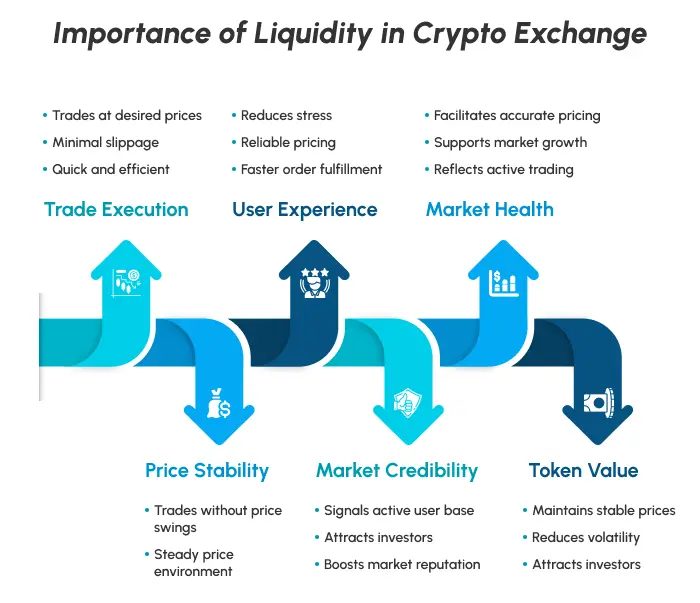
Trade Execution
High liquidity means quick, efficient execution. With many buy and sell orders on the book, traders enter and exit positions with minimal slippage, and orders fill at or close to the expected price.
Price Stability
In a liquid market, large trades are absorbed without big price swings. That stability prevents sudden moves that hurt traders and invites manipulation on thin books.
User Experience
Traders get a predictable experience: orders fill faster and prices stay reliable. A spread of 0.4% on a $1,000 round trip is a hidden $4 cost, four times a 0.1% trading fee, so users feel liquidity even when they cannot name it.
Market Credibility
Liquid markets look credible. Exchange rankings reflect this: the Kaiko Exchange Ranking for Q3 2026 scores venues across six categories that include liquidity, and the top 10 scored between 67 and 79. Institutional traders and token projects check such rankings before they connect.
Market Health
High liquidity signals active trading and efficient price discovery, which are essential for growth and stability.
Token Value
For listed tokens, deep liquidity keeps prices steadier, attracts more investors and builds confidence. Projects choose listing venues partly on the depth they can expect.
How to Measure Liquidity on Your Cryptocurrency Exchange
Measuring liquidity tells you how your platform performs and where to act. Use these metrics together, because each one can look healthy while another fails.
- Bid-ask spread: the difference between the best bid and the best ask, usually quoted in basis points (bps, where 1 bp = 0.01%). For scale, Kaiko's January 2026 snapshot put average spreads at 0.12 bps for BTC, 0.11 bps for ETH and 0.92 bps for SOL across the markets it tracks. A new exchange will not match that on day one, but it should set a spread target per pair.
- Market depth at 1% and 2%: the dollar value of resting orders within 1% (or 2%) of the mid-price on each side. Kaiko's guide to centralized exchange liquidity data defines depth as the sum of limit orders a set percentage from the mid-price, notes that 1% depth is watched mostly by longer-term holders and 0.1% by high-frequency traders, and warns that 2% depth, the level listing sites report, is more often gamed. Track both and watch for orders that sit just inside 2% but never trade.
- Slippage on a standard order: the percentage gap between the mid-price and the average fill price for a set order size, such as $10,000 or $100,000, calculated separately for buys and sells. This is the number your users actually pay.
- Trading volume, read with care: volume over 24 hours shows activity, but it is the easiest metric to inflate, so compare it with depth. High volume with thin depth is a warning sign.
- Uptime of quotes: the share of time each pair meets its spread and depth targets, especially overnight and at weekends.
Kaiko reported that in January 2026 BTC depth within 1% of the mid-price reached $631.1 million across the venues it tracks, with Binance at $268.6 million, Bybit at $151.3 million and OKX at $126.0 million, and the top three holding 86% of the total. That concentration is the core problem a new exchange has to solve.
Consequences of Low Liquidity
During the early stages of a new exchange or a new token listing, low liquidity means wide spreads, higher transaction costs and poor execution. Few participants lead to sharp price swings, so users cannot trade at the prices they expect.
Low liquidity also makes orders slower to fill and turns ordinary market moves into extreme ones. Stress shows how fast depth can vanish: on 10 October 2025, FTI Consulting reports that more than $19 billion of crypto leverage was liquidated in about a day, BTC's best-price resting size fell by more than 90% on key venues and spreads widened from single-digit basis points to double-digit percentages at the extremes.
These problems drive away traders and undermine confidence, which hurts the stability and reputation of your exchange. Planning for liquidity, including stress days, is therefore part of the product, not an afterthought.
Market Makers and Their Contracts
Market makers are firms that quote both sides of the order book continuously, so traders always find a counterparty. For a new exchange or a newly listed token, a market maker agreement is usually the first source of depth.
The two common commercial models
- Retainer model: the exchange or token project pays a fixed monthly fee for defined services, sometimes with a loan of inventory. It costs more in cash but keeps incentives clear.
- Loan and call option model: the token project lends tokens to the market maker, which is paid through options to buy those tokens later at set prices. It needs little cash, but a Cointelegraph investigation in April 2025 found that KPIs in many such deals were "missing or vague", and that several projects using them were left worse off.
The KPIs every agreement should state
| KPI | What to write into the contract | Why it matters |
|---|---|---|
| Maximum spread | For example, 20 bps on major pairs, 50 bps on long-tail pairs | A tight spread with no size behind it is worthless |
| Minimum depth | A dollar amount per side within 1% and 2% of the mid-price, per pair | Depth is meaningful only at a stated distance |
| Uptime | The share of time spread and depth are met together, with the sampling interval and a cap on the longest outage | An average can hide a long weekend gap |
| Venue and pair list | Exactly which markets the obligations cover | Obligations on one venue say nothing about another |
| Reporting | Daily or weekly reports from exchange data, not the market maker's own figures | Lets you check the work |
| Exit and inventory return | Notice period and return of any loaned tokens or funds | Protects you if service fails |
The spread and depth figures above are examples to adapt per pair, not industry standards.
What never belongs in a market making deal
Wash trading. Volume created by trades that cancel each other out is market manipulation. In the US, the Justice Department's "Operation Token Mirrors" charged market makers that sold such services; Gotbit and its founder were sentenced in 2025, with the firm forfeiting about $23 million. The EU's MiCA regulation prohibits market abuse involving crypto-assets, and Dubai's VARA rulebooks include market conduct rules for licensed firms. Build surveillance into your matching engine that flags self-trades and circular trades between linked accounts.
Liquidity Sharing and Aggregation
A new exchange rarely has enough natural flow to fill its books. Two techniques bridge the gap.
- Liquidity sharing: the exchange connects its order book to a larger venue through a broker or link programme, so user orders that cannot fill locally are hedged or routed there. Users see deeper books from day one, while the exchange keeps its own brand, accounts and fees.
- Liquidity aggregation: the exchange pulls order books from several external venues, combines them into one view and routes orders to the best price, adding a markup where its licence and disclosures allow.
Both need careful engineering: real-time price feeds, risk limits on the hedge account, reconciliation and clear disclosure of how orders are executed. Pixel's guide to crypto exchange architecture shows where the liquidity bridge sits beside the matching engine, wallets and risk engine. Many founders start with a white-label crypto exchange that already includes a liquidity API, then add their own market makers as volume grows.
The goal is to move from imported liquidity to your own. Track the share of fills that come from your own users each month; if it is not rising, incentives or listings need work.
Worked Example: Slippage on a Thin Book vs a Deep Book
Here is the maths behind the takeaway, using a simplified order book for a BTC pair.
Thin book (before a market maker): the ask side holds $20,000 at 0.1% above mid, $30,000 at 0.5%, $50,000 at 1% and $100,000 at 2%. A trader sends a $75,000 market buy.
- Fills: $20,000 at +0.1%, $30,000 at +0.5%, then $25,000 at +1%
- Weighted premium: (20,000 x 0.1% + 30,000 x 0.5% + 25,000 x 1%) / 75,000 = ($20 + $150 + $250) / 75,000 = 0.56%
- Slippage cost: $75,000 x 0.56% = about $420
Deep book (after a market maker adds depth near the mid): the ask side now holds $60,000 at 0.1% and $90,000 at 0.5%.
- Fills: $60,000 at +0.1%, then $15,000 at +0.5%
- Weighted premium: ($60 + $75) / 75,000 = 0.18%
- Slippage cost: about $135
The trader saves about $285 on one order, and depth within 1% rose from $100,000 to at least $150,000 per side. Set your depth target from your users' order sizes: if your typical large order is $75,000, aim for at least that much within 0.5% of the mid-price on each side of your main pairs.
How to Improve Liquidity on Your Crypto Exchange Platform
Boosting liquidity raises trading activity and stabilises your exchange. These strategies work best together.
Enhance Market Making
Sign market makers with written KPIs, as above, and offer professional traders a market maker programme with maker rebates and API rate limits that suit them. Effective market making tightens spreads and makes your platform attractive to retail and institutional traders.
Encourage Higher Trading Volumes
Use maker-taker fees with lower or negative maker fees, VIP tiers, fee discounts for holders of an exchange token and targeted campaigns. Pixel's guide to crypto exchange revenue streams shows how to fund these incentives without giving away all of the fee income.
Leverage Partnerships and Integrations
Connect to larger venues through liquidity sharing or aggregation, list stablecoin pairs that traders already use, and work with token projects on joint listing and liquidity plans. Automated tools such as a crypto trading bot can keep in-house quotes alive outside office hours, within strict risk limits.
Enhance Security Measures
A secure platform builds trust, and trust brings volume. Use strong cryptocurrency exchange security protocols such as multi-signature wallets, cold storage, two-factor authentication and DDoS protection, plus trade surveillance against wash trading and spoofing.
Sequence Your Launch
Liquidity is easier to build pair by pair than all at once. A practical order:
- Before launch: sign at least one market maker, connect a liquidity bridge, and choose 5 to 10 pairs you can make deep, usually BTC, ETH and leading tokens against a major stablecoin.
- Launch: open only those pairs, publish your fee schedule and maker programme, and monitor spread, depth and uptime per pair every day.
- Months 1 to 3: add pairs only when they can meet the same depth target, run volume campaigns and onboard professional traders through the API.
- Months 3 to 12: add token listings with project-funded liquidity commitments, reduce reliance on the bridge as your own flow grows, and stress-test risk limits for days like 10 October 2025.
Pixel's step-by-step guide on how to start a cryptocurrency exchange covers licensing, banking and the rest of the launch plan.
What It Costs to Build an Exchange With Liquidity Built In
Liquidity tooling belongs in the exchange from the start: a matching engine that supports market maker APIs, a liquidity bridge, surveillance and reporting dashboards. Pixel Web Solutions publishes its exchange pricing:
| Exchange type | Pixel Web Solutions price |
|---|---|
| White-label crypto exchange | $25,000 to $50,000 |
| Hybrid exchange | $80,000 to $180,000 |
| Custom crypto exchange | $100,000 to $150,000+ |
| Trading bot (single strategy) | From $6,000 |
Market maker retainers, liquidity bridge fees and seed inventory are separate operating costs that vary by pair and provider, so budget them in your first-year plan.
Final Verdict
Crypto exchange liquidity decides whether a new platform survives its first year. It lets traders fill orders quickly at fair prices, it builds credibility with institutions and token projects, and it protects users on stress days. Measure it properly, contract for it with clear KPIs, import it through sharing and aggregation, and launch only the pairs you can make deep.
For startups that want an exchange built for strong liquidity from day one, an experienced development partner makes the difference. Pixel Web Solutions, a cryptocurrency exchange development company, builds exchanges with market maker APIs, liquidity bridges, surveillance and the reporting dashboards that crypto exchange liquidity management needs. To plan your exchange and its liquidity strategy, contact Pixel Web Solutions.
Frequently Asked Questions
What is liquidity in a crypto exchange?
Liquidity is the ability to buy or sell an asset on the exchange quickly at a price close to the market rate. It shows up as tight bid-ask spreads, deep order books near the mid-price and low slippage on typical order sizes.
How do you measure crypto exchange liquidity?
Track the bid-ask spread in basis points, order book depth within 1% and 2% of the mid-price on each side, slippage on a standard order size, and the uptime of quotes. Read trading volume alongside depth, because volume alone is easy to inflate.
How can a new crypto exchange get liquidity?
Sign market makers with written spread, depth and uptime obligations, connect to larger venues through liquidity sharing or aggregation, launch with a small set of deep pairs, and use maker rebates and VIP tiers to attract professional traders.
What is the difference between 1% and 2% market depth?
1% depth is the value of orders within 1% of the mid-price; 2% depth counts orders within 2%. 2% depth is always larger and is the figure listing sites often show, so it is easier to game; 1% depth and slippage tell you more about real execution.
Is paying a market maker legal?
Yes, paying for genuine two-sided quoting is a normal service. Paying for wash trading or fake volume is market manipulation and has led to criminal convictions in the US. Write KPIs into the contract and monitor trades for self-dealing.
How much does it cost to build a crypto exchange?
Pixel Web Solutions prices a white-label crypto exchange at $25,000 to $50,000, a hybrid exchange at $80,000 to $180,000 and a custom exchange at $100,000 to $150,000 or more. Market maker fees and liquidity bridge costs, which pay for crypto exchange liquidity after launch, are separate operating expenses.