









Crypto exchange scalability is a platform's ability to handle more users, orders and market data without slowing down, failing or becoming less secure. To scale a crypto exchange, you shard the matching engine by market, scale stateless services horizontally, stream market data efficiently, run across several cloud zones or regions, and load test for volatility spikes many times your normal traffic. Exchanges that skip this work tend to break on exactly the days traders need them most.
When you start a new crypto exchange business, everything might seem smooth. Once your user base grows and you become more popular, things get tough if the exchange is not scalable. Users face slower order execution, outages and frozen withdrawals, and complaints pile up. With today's competition, startups cannot treat scalability as an afterthought.
The past year proved it. During the 10 October 2025 crash, Binance paid $283 million in compensation to users hit by depegged collateral prices on its platform, and Coinbase suffered multi-hour outages in October 2025 and May 2026 when its cloud provider failed. In this guide, we'll cover what scalability means, the key factors behind it, published performance benchmarks, real failures and a step-by-step plan to scale your platform.
Key Takeaways
- The matching engine is the hard limit: matching for one market is sequential, so you scale by sharding markets across engines, not by adding threads to one book.
- Market data often outgrows trading: pushing order book updates to thousands of WebSocket clients can need far more messages per second than matching itself, as the worked example below shows.
- Plan for volatility, not averages: load test at many times normal traffic; the 2025 crash, AWS outages and API overloads all hit at peak moments.
- One cloud zone is not enough: Coinbase said its systems could survive a single-zone failure, but a multi-zone AWS outage in May 2026 still took trading offline.
- Benchmarks need context: published figures range from about 200,000 orders per second on Hyperliquid's mainnet to 6 million per second on a single LMAX thread, measured very differently.
What Is Scalability in a Crypto Exchange?
In cryptocurrency exchanges, scalability is the platform's ability to manage growing transaction volumes and users while keeping performance, security and reliability intact. It involves scaling up (adding power to existing infrastructure) and scaling out (adding more machines or regions to absorb growth).
A scalable exchange processes orders quickly, serves a growing user base without overload, and keeps uptime steady during peak trading or sudden surges. Crypto exchange scalability covers four layers:
- Order flow: how many orders, cancels and amendments per second the gateway, risk checks and matching engine can handle.
- Latency: how long an order takes from submission to acknowledgement and fill, including the slowest 1% of orders.
- Market data: how many order book and trade updates the platform can stream to users and API clients.
- Wallets and back office: how fast deposits are credited, withdrawals processed and balances settled as volume grows.
Now let us see why it matters so much.
Why Is Scalability Important for Your Crypto Exchange?
Scalability lets you adapt to the dynamic nature of the crypto industry, where technology and market demands constantly change. A scalable platform ensures smooth trading and satisfied users. It also gives you the flexibility to add new technologies, respond to regulatory changes and strengthen security as you expand.
User Experience
Scalability keeps your crypto exchange responsive and reliable as user numbers grow. It prevents delays and outages by handling rising volumes smoothly, which keeps users engaged and loyal.
A scalable platform delivers minimal lag and fast order processing, leading to higher satisfaction and retention. In addition, creating a mobile app for your crypto exchange supports a scalable user experience by letting users trade on the go, boosting engagement as demand rises. A scalable system also lets you add new features, cryptocurrencies and trading pairs without a complete overhaul.
Operational Efficiency
A scalable exchange makes the most of its resources, handling transactions and data efficiently. The result is fewer interruptions, lower upgrade costs and smoother daily operations.
Efficient scalability also means resources can be allocated dynamically, adjusting in real time to demand. This flexibility reduces waste, improves performance and makes monthly infrastructure costs more predictable.
Also Read: How Much Does It Cost to Build a Crypto Exchange in 2026
Competitive Advantage
In a crowded crypto market, scaling quickly and effectively gives you an edge. It lets you handle more users and transactions without compromising performance, positioning your exchange as a reliable and modern choice for traders. Market makers, in particular, judge venues by API latency and uptime; they bring liquidity only to exchanges that stay up during volatility.
Future Growth
Scalability prepares your exchange for expansion by accommodating new features, more users and higher volumes without major rebuilds. This forward-thinking approach means your platform can evolve with the market.
By integrating scalable technologies and architectures, you can introduce new products, such as derivatives or new regions, while keeping pace with regulatory requirements. As a result, you build a resilient, adaptable exchange positioned for long-term success.
To improve scalability in your crypto exchange, you first need to know the key factors.
Key Factors Determining Scalability in a Crypto Exchange
Focusing on these factors helps your crypto exchange handle rising demand and scale effectively. Each one improves performance and reliability so your platform is ready for growth.
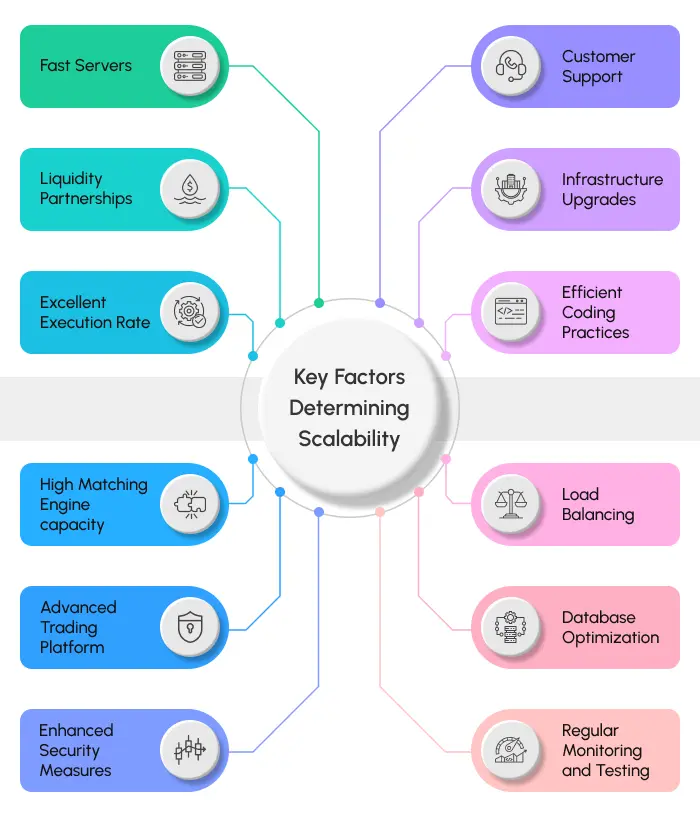
1. Fast Servers
High-performance servers reduce latency and speed up order processing. Fast, well-tuned servers let your exchange handle high volumes with minimal delays, which improves user satisfaction.
2. Liquidity Partnerships
Partnering with liquidity providers or other exchanges boosts your platform's ability to handle larger trades. This deepens the order book and keeps prices competitive.
3. Excellent Execution Rate
A high execution rate means orders are filled promptly and accurately. This reduces slippage and makes your exchange more appealing to active traders.
4. High Matching Engine Capacity
A robust matching engine handles a high volume of orders efficiently. Because matching for a single market is sequential, capacity comes from a fast single-threaded core per market plus sharding many markets across engines, so trades are matched quickly even at peak times.
5. Advanced Trading Platform
A feature-rich trading platform attracts more users and supports complex strategies. However, each new order type and product adds load to the risk engine, so design features with performance in mind.
6. Enhanced Security Measures
Strong security protocols protect user data and assets, and they must scale with traffic. Encryption, multi-factor authentication and DDoS protection build trust and keep the platform safe as it grows.
7. Customer Support
Responsive support resolves issues quickly. A well-supported user base experiences fewer frustrations and stays loyal.
8. Infrastructure Upgrades
Regular upgrades let your infrastructure handle heavier loads and integrate new technologies. Keeping systems current supports scalability and performance.
Also Read: Tech Stack to Launch a Crypto Exchange: A Complete Guide
9. Efficient Coding Practices
Efficient, optimized code uses fewer resources and performs better. Well-structured code is easier to maintain and handles higher traffic without slowdowns.
10. Load Balancing
Distributing traffic across multiple servers prevents any single server from being overwhelmed. Load balancing keeps your exchange available during high-traffic periods.
11. Database Optimization
Efficient database management gives quick access to data and supports high volumes. Keep the live order book in memory, write events to an append-only log, and move history and reporting to separate read replicas.
12. Regular Monitoring and Testing
Continuous monitoring and testing catch issues before they reach users. Track p99 latency, queue depth and error rates, not just averages.
Addressing these factors improves your exchange's scalability, so it can handle rising traffic and deliver a better experience. Next, let's look at what fast actually means.
Matching Engine Benchmarks: Published Figures and What They Mean
Many vendors quote "millions of transactions per second" without saying how they measured it. Here are figures published by the operators themselves or by reputable press, with their context.
| Platform | Published figure | Context |
|---|---|---|
| LMAX Exchange (FX) | 6 million orders per second on a single thread | Business logic processor only, 2011 benchmark on one server; no network, risk or persistence in the figure |
| Binance | About 1.4 million orders per second at launch, as reported by Decrypt in 2020 | Press figure, not an official Binance benchmark; Binance rewrote its engine in 2020 without publishing new numbers |
| Hyperliquid (on-chain order book) | About 200,000 orders per second on mainnet | Official docs; median end-to-end latency 0.2 seconds, 99th percentile 0.9 seconds for co-located clients |
Two lessons follow. First, ask what was measured: orders, messages or trades, with or without risk checks and persistence. Second, a single benchmark rarely limits a real exchange; gateways, risk engines, databases and market data usually saturate first. For a new exchange, tens of thousands of orders per second with stable p99 latency is a far more useful target than a headline number.
Real-World Scalability Failures in Crypto Exchanges (2025 to 2026)
Scalability problems hit performance and user trust hardest during market extremes. The old textbook example is Bitcoin's network congestion in late 2017, but recent incidents teach more for an exchange builder.
| Date | Incident | What failed | Lesson |
|---|---|---|---|
| 29 July 2025 | Hyperliquid's API servers saw a traffic spike that delayed orders for about 37 minutes; the exchange refunded affected users roughly $2 million | API layer overload while the chain kept producing blocks | Scale and rate-limit the gateway separately from the core engine |
| 10 October 2025 | During a crash with about $19 billion of leveraged positions liquidated market-wide, collateral like USDe, wBETH and BNSOL depegged on Binance's own books | Collateral was priced from the exchange's own thin order books under stress | Price collateral from robust indexes and redemption values; stress test the risk engine, not just matching |
| 20 October 2025 | An AWS outage in the US-East-1 region took down Coinbase and many other services for hours | Dependence on one cloud region | Plan multi-region failover for critical paths |
| 7 May 2026 | Rising temperatures in an AWS service across several US-East availability zones disrupted Coinbase trading for hours; markets went to cancel-only | Multi-zone failure beyond the single-zone design | Test region-level failover and a safe degraded mode |
Without the ability to absorb surges, exchanges risk operational failure and lost trust. To overcome scalability issues, crypto exchanges should combine load balancing, high-capacity sharded matching engines, optimized databases and multi-region infrastructure. In addition, partnering with liquidity providers helps absorb larger trading volumes during peak demand.
Worked Example: Capacity Planning for a Growing Exchange
Competitor guides rarely show the maths. The numbers below are illustrative assumptions for a mid-sized exchange, not measurements; replace them with your own data.
Order flow at peak. Assume 20 market-maker API clients each send 500 orders and cancels per second, and 10,000 retail users are active, each placing about one order every 30 seconds.
- Market makers: 20 × 500 = 10,000 messages per second
- Retail: 10,000 ÷ 30 ≈ 333 messages per second
- Total normal peak: about 10,300 messages per second
Volatility multiplier. If a crash multiplies order flow tenfold, the engine must survive about 103,000 messages per second. With 2x safety headroom, your load test target becomes roughly 200,000 messages per second, about the same as Hyperliquid's published mainnet capacity.
Market data fan-out. Now assume 10,000 WebSocket clients each subscribe to 5 order books, and each book updates 50 times per second during volatility:
- 10,000 × 5 × 50 = 2.5 million outbound messages per second
That is about 12 times the order-flow target. For most exchanges, market data distribution, not matching, is the first bottleneck. The fix is to batch and conflate updates (send the latest state every 100 milliseconds instead of every change), publish snapshots plus diffs, and serve them from a horizontally scaled gateway tier fed by the engine's event stream.
Market sharding. Matching is sequential per market, so place your busiest pairs (for example BTC/USDT) on dedicated engine instances and group long-tail pairs together. A market can then fail over without stopping the rest of the exchange.
How to Scale Your Crypto Exchange Platform
Scaling a crypto exchange supports growth and meets user demand. It requires focus on infrastructure, liquidity, security, user experience, compliance and support. Here is a guide to the essential strategies, starting with the crypto exchange architecture itself.
Infrastructure Scaling
A well-scaled infrastructure is the backbone of any successful crypto exchange. Rising volumes require robust servers, upgraded databases and scalable cloud solutions. High availability, low latency and quick response times directly affect user experience and trust.
To scale infrastructure effectively:
- Implement load balancers: distribute incoming requests evenly across servers, minimizing downtime even under heavy load.
- Combine vertical and horizontal scaling: vertical scaling adds power to the latency-critical matching core, while horizontal scaling adds servers for stateless gateways, APIs and market data.
- Use an event-sourced core: a sequencer orders every incoming instruction, the matching engine processes it in memory, and every event is written to a replicated log, so a standby engine can replay the log and take over in seconds.
- Separate critical paths: isolate order entry, market data, wallets and back office so a spike in one does not freeze the others.
- Go multi-zone and multi-region: run hot standbys in separate availability zones and keep a tested plan for a full region failure.
- Content delivery networks (CDNs): cache and deliver static content from servers close to users, speeding up page loads for global audiences.
Enhancing Liquidity
Liquidity is vital for a healthy exchange. High crypto exchange liquidity lets users buy and sell quickly without large price moves, promoting smoother execution and attracting more participants.
To enhance liquidity:
- Partner with liquidity providers: professional market makers increase order book depth and reduce spreads.
- API integration with external exchanges: connecting to other venues taps external liquidity pools, reducing slippage on large trades.
- Give market makers dedicated capacity: separate rate limits, co-location or premium API tiers keep their quotes flowing during volatility.
Advanced Security Measures
As volumes grow, exchanges attract more cyber threats. Scalable security protects both assets and user trust. With sensitive data and funds at stake, advanced crypto exchange security measures are essential.
Effective security measures include:
- Multi-signature and MPC wallets: requiring multiple keys or key shares to authorize transfers reduces the risk of unauthorized withdrawals.
- DDoS protection: filtering attack traffic at the edge keeps the platform up during attacks that often coincide with market events.
- Rate limiting: per-user and per-API-key limits stop one client from overloading the system.
- Strong encryption practices: TLS everywhere, encrypted storage and secure hashing protect user data and transaction information.
User Experience Optimization
As the user base expands, a seamless, intuitive experience becomes essential. A confusing or slow interface drives users away, especially under high traffic.
To optimize user experience:
- UI/UX improvements: update the interface regularly to keep it intuitive for new users.
- Mobile optimization: a mobile-first platform serves on-the-go users and expands reach.
- Graceful degradation: when parts of the system are under stress, show clear status messages and switch to safe modes such as cancel-only, rather than failing silently.
- Continuous testing: run ongoing tests to catch issues before users do.
Regulatory and Compliance Upgrades
As exchanges grow internationally, meeting regulatory standards in each region gets more complex. Non-compliance can bring penalties or restrictions, so compliance must scale too.
To stay compliant:
- Update KYC/AML processes: automate identity checks and transaction monitoring so onboarding keeps pace with sign-ups.
- Follow regional regulations: work with legal experts in each market. In the EU, the Digital Operational Resilience Act (DORA) has required crypto-asset service providers licensed under MiCA to manage ICT risk and test operational resilience since 17 January 2025, and Dubai's VARA sets technology rules for licensed exchanges.
Also Read: Cryptocurrency Exchange Regulations and Compliances: A Complete Guide
Customer Support Expansion
A growing exchange receives more customer questions. To keep users, support must be responsive and grow with the platform.
To scale customer support effectively:
- Invest in AI chatbots: they answer frequent questions instantly and route complex cases to people.
- 24/7 customer support: round-the-clock support serves users in every time zone.
- Multilingual support: support in several languages improves satisfaction for a global audience.
- Public status page: during incidents, a live status page cuts ticket volume and builds trust.
Crypto Exchange Scalability Checklist Before Launch
Use this checklist to judge whether a platform is ready for growth:
- Load tested at 10x expected peak order flow, with p99 latency recorded
- Market data fan-out tested with realistic WebSocket client counts
- Busiest markets on dedicated matching engine shards
- Event log replicated, with standby engine failover tested
- Multi-zone deployment live and a region failover drill completed
- Per-key rate limits and a cancel-only degraded mode in place
- Collateral and mark prices sourced from robust indexes
- Hot wallet float sized for peak withdrawal days
Frequently Asked Questions
What is crypto exchange scalability?
It is the ability of an exchange to handle more users, orders, market data and withdrawals without slowing down, failing or weakening security. It depends on the matching engine, gateways, databases, market data distribution and cloud architecture.
How many orders per second should a crypto exchange handle?
There is no single standard. Size capacity from your expected peak order flow, multiply by a volatility factor of around 10x, and add headroom. For reference, Hyperliquid publishes about 200,000 orders per second on its mainnet.
Why do crypto exchanges go down during volatility?
Order flow, market data and logins all spike at once. If any layer, such as the API gateway, the risk engine or a single cloud region, reaches its limit, users see errors or frozen accounts. The 2025 and 2026 incidents above show each of these failure types.
Is cloud or bare metal better for a crypto exchange?
Many exchanges use both: bare metal or dedicated instances for the latency-critical matching core, and cloud services for elastic gateways, APIs and back office. Whatever the mix, avoid dependence on one data center or region.
How much does it cost to build a scalable crypto exchange?
Pixel Web Solutions prices white-label crypto exchanges at $25,000 to $50,000 and custom exchanges at $100,000 to $150,000 or more. Hybrid exchanges cost $80,000 to $180,000. Infrastructure, monitoring and load testing are ongoing monthly costs on top.
Scale Your Crypto Exchange with Pixel Web Solutions
In the competitive landscape of cryptocurrency exchanges, prioritizing crypto exchange scalability is crucial. By addressing it from the outset, operators keep their platform responsive and reliable as users and volumes grow. Scalable exchanges handle market swings better, attract a broader user base and sustain growth over time.
Building a scalable crypto exchange improves performance and lays the foundation for long-term success. Expert guidance makes all the difference if you are just starting out.
Pixel Web Solutions provides crypto exchange development services designed around your business needs, from sharded matching engines and event-sourced cores to multi-region deployment and load testing. Its team delivers secure, scalable, high-performance trading platforms, and it also builds hybrid crypto exchanges that combine order book speed with self-custody. To plan your exchange's capacity, talk to Pixel Web Solutions and make crypto exchange scalability a strength from day one.