










Cryptocurrency exchange compliance means holding the right licence in every market you serve and running the controls regulators require: KYC, transaction monitoring, sanctions screening, Travel Rule data sharing, capital, custody and tax reporting. In September 2026 that means a MiCA CASP authorisation in the EU, FinCEN registration plus state licences in the US, FCA registration today and FCA authorisation by October 2027 in the UK, and licences from VARA, MAS or FIU-IND elsewhere.
Cryptocurrency exchange regulations have moved faster in the last 20 months than in the five years before. The EU's Markets in Crypto-Assets Regulation (MiCA) has applied in full since 30 December 2024, and its transitional period ended on 1 July 2026. In the United States, the GENIUS Act became the first federal crypto statute in July 2025, and the SEC and CFTC published a token taxonomy in March 2026. The UK opens applications for its new crypto regime on 30 September 2026.
For founders, creating a crypto trading platform that meets these rules can still feel like a nightmare. This guide sets out who regulates crypto exchanges, what each regulator requires as of September 2026, which rules are in force and which are still pending, and how each rule turns into a feature your exchange software must have.
Key Takeaways
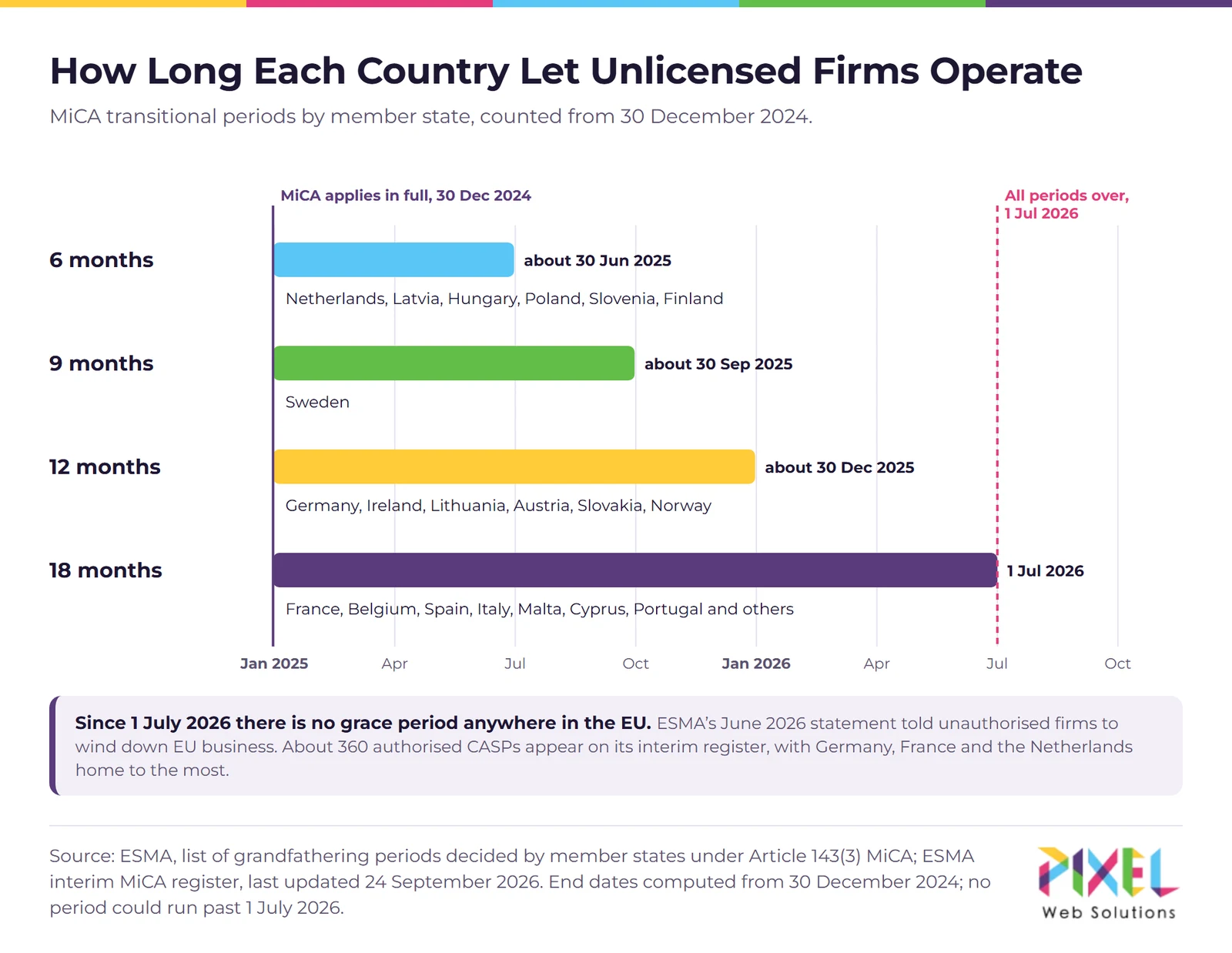
- The EU grace period is over: MiCA's transitional period ended across the EU on 1 July 2026, and ESMA told unauthorised firms to wind down EU business. About 360 entities now appear on ESMA's interim register of authorised CASPs.
- US rules are clearer but not finished: the GENIUS Act (stablecoins) is law, the SEC and CFTC token taxonomy took effect in March 2026, but the CLARITY Act for market structure is still pending after a Senate procedural vote failed on 15 September 2026.
- The UK is switching regimes: FCA authorisation applications run from 30 September 2026 to 28 February 2027, and the new regime starts on 25 October 2027. Existing FCA registration does not convert automatically.
- Travel Rule is near-universal: 91 of 109 jurisdictions assessed by FATF had passed Travel Rule laws by July 2026, and the EU applies it to crypto transfers of any amount.
- Compliance failures are software failures: Coinbase Europe was fined €21.5 million because a misconfigured monitoring system missed more than 30 million transactions.
What are Cryptocurrency Exchange Regulations?
Cryptocurrency exchange regulations are the rules that define how crypto exchanges must be set up and operated within a regulated framework. Every country has its own financial laws and builds its crypto rules on top of them, so regulations for cryptocurrency exchanges vary from country to country. The goal is the same everywhere: stop illegal activity and protect people's funds.
Regulatory bodies write and enforce these rules. Their work covers AML (Anti-Money Laundering) and CFT (Combating the Financing of Terrorism) policies, crypto exchange licences, capital and custody requirements, market conduct and consumer protection. Cryptocurrency exchange compliance is the exchange's side of that relationship: the licences it holds, the controls it runs and the records it keeps to prove it follows the rules.
Major Regulatory Bodies for Crypto Exchange Regulation
Each country has its own regulators for crypto trading, and a few global bodies set the standards they follow. The most important regulatory bodies for crypto exchanges are:
- FATF (Financial Action Task Force), the global AML standard-setter
- SEC (Securities and Exchange Commission) and CFTC (Commodity Futures Trading Commission) in the US, with FinCEN for AML and state regulators such as NYDFS for licences
- FCA (Financial Conduct Authority) in the UK
- ESMA (European Securities and Markets Authority) and national competent authorities in the EU
- VARA in Dubai, MAS in Singapore and FIU-IND in India
FATF
FATF, or the Financial Action Task Force, is an inter-governmental body that sets global standards against money laundering and terrorist financing. It does not license exchanges itself, but almost every national crypto rule traces back to its Recommendation 15 on virtual assets and its Travel Rule. FATF maintains two lists:
- Black list (high-risk jurisdictions subject to a call for action): countries with serious strategic deficiencies. As of the June 2026 plenary, the list is North Korea (DPRK), Iran and Myanmar.
- Grey list (jurisdictions under increased monitoring): countries working with FATF to fix deficiencies. Kenya remains on it, and Bosnia and Herzegovina and Iraq were added in June 2026. The Philippines, once on this list, was removed in February 2025.
Screen every user and counterparty against these lists and apply enhanced due diligence to grey-list exposure. FATF's July 2026 targeted update found that 91 of 109 jurisdictions (83%) had passed Travel Rule legislation, yet almost half of them had taken no supervisory or enforcement action. In June 2025 FATF also revised Recommendation 16 on payment transparency, with changes due to take effect by the end of 2030.
SEC
The SEC, or Securities and Exchange Commission, was created after the 1929 crash to keep securities markets fair and efficient. It regulates exchanges, brokers, dealers and advisers that deal in securities, and it is led by five commissioners appointed by the US President and confirmed by the Senate. Its key responsibilities include:
- Overseeing corporate disclosure
- Enforcing securities laws
- Facilitating capital formation
- Protecting investors
For crypto exchanges, the question is which tokens are securities. The SEC launched a Crypto Task Force led by Commissioner Hester Peirce on 21 January 2025. On 17 March 2026 it issued an interpretation, joined by the CFTC, with a token taxonomy of five categories: digital commodities, digital collectibles, digital tools, stablecoins and digital securities. SEC Chairman Paul Atkins said the interpretation recognises that most crypto assets are not themselves securities.
On 18 August 2026 the SEC went further and proposed Regulation Crypto Assets, with two offering exemptions (up to $5 million over four years, and up to $75 million per 12 months) and a conditional safe harbour from the "investment contract" definition. It is a proposal, open for comment, and not yet in force. For how token type affects listing decisions, see our guide to utility tokens vs security tokens.
FCA
The UK's FCA, or Financial Conduct Authority, is the independent regulator of the UK's financial markets, accountable to HM Treasury and Parliament. Its operational objectives are:
- To promote healthy competition in financial markets
- To protect consumers, including crypto users
- To enhance the integrity of the UK financial system
The FCA has supervised cryptoasset businesses for AML since 10 January 2020, so any exchange serving UK customers must be registered with the FCA today. The UK Travel Rule has applied since 1 September 2023, and strict crypto marketing rules since 8 October 2023.
A full authorisation regime is coming. The Financial Services and Markets Act 2000 (Cryptoassets) Regulations 2026 were made on 4 February 2026 and commence in full on 25 October 2027. The FCA's application gateway opens at 7am on 30 September 2026 and closes on 28 February 2027, and registered firms get no automatic conversion: they must apply. The detailed rules are in the FCA's June 2026 policy statements.
ESMA
ESMA, the European Securities and Markets Authority, is the EU agency that promotes stable and orderly financial markets and investor protection. Its three main objectives are:
- Investor protection
- Financial stability
- Orderly markets
Under MiCA, ESMA writes technical standards, coordinates national regulators and keeps the EU register of crypto-asset service providers (CASPs). The licence itself comes from a national competent authority in one member state, such as BaFin in Germany or the AMF in France, and then passports across the EU. ESMA's interim MiCA register, last updated on 24 September 2026, lists about 360 authorised CASPs, with Germany, France and the Netherlands home to the most.
These regulators revise their rules often, so compliance is a continuing job, not a one-time filing.
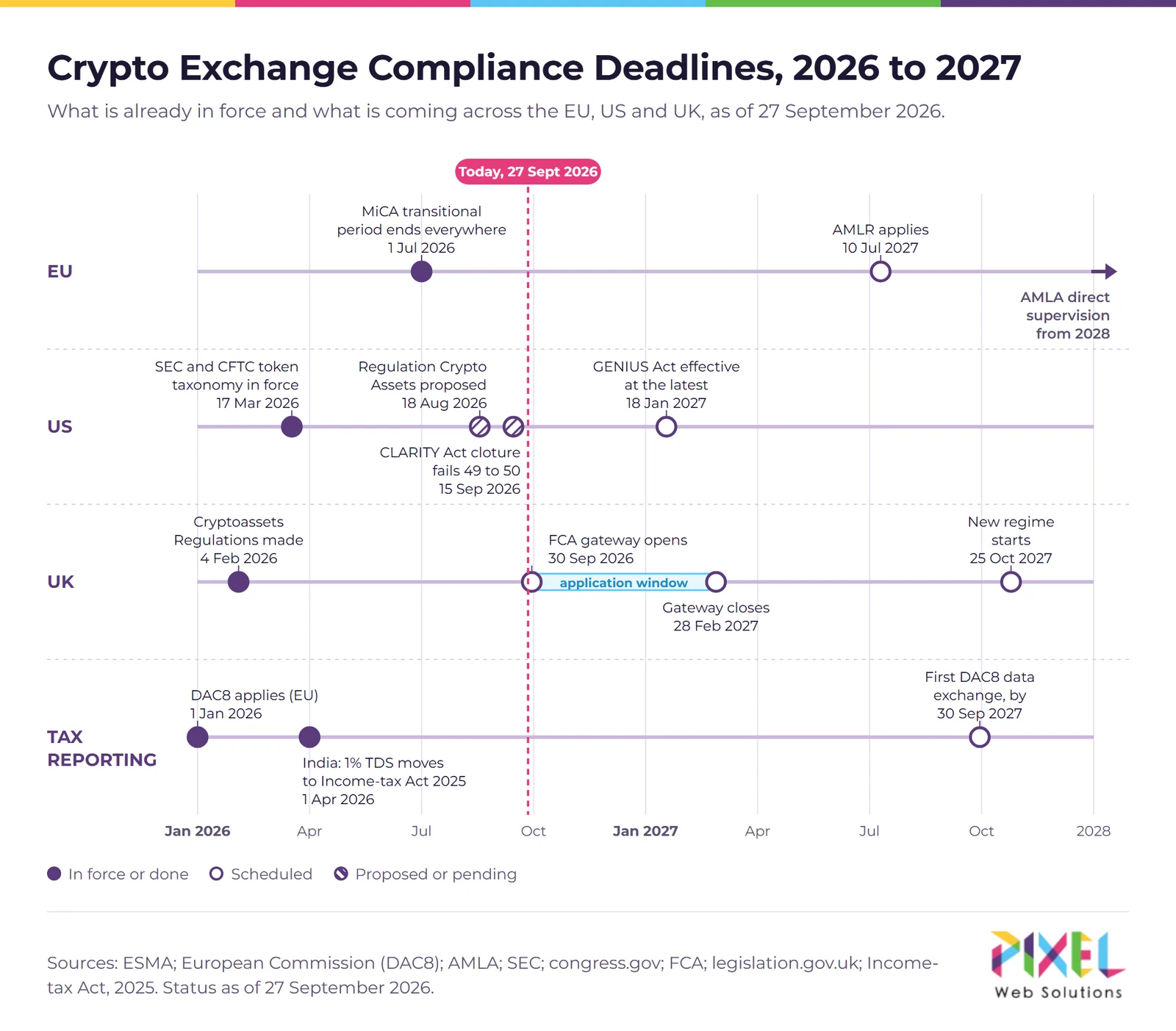
Crypto Exchange Compliance Status by Country (September 2026)
Competitor guides list regulators; few tell you which rules are actually in force today. This table does, as of 27 September 2026.
| Jurisdiction | Regulator and licence | Status on 27 Sept 2026 | Key dates |
|---|---|---|---|
| European Union | National authority, MiCA CASP authorisation under Regulation (EU) 2023/1114 | In force; transitional period over | Full application 30 Dec 2024; all grandfathering ended 1 Jul 2026 |
| EU AML | Anti-Money Laundering Authority (AMLA), AMLR | Adopted, applies later | AMLR applies 10 Jul 2027; AMLA direct supervision from 2028 |
| United States (federal) | FinCEN MSB registration | In force | Crypto exchangers are money transmitters under FinCEN guidance FIN-2019-G001 |
| United States (securities) | SEC and CFTC token taxonomy | In force (interpretation) | Issued 17 Mar 2026; Regulation Crypto Assets proposed 18 Aug 2026 |
| United States (stablecoins) | GENIUS Act (S.1582) | Law, not yet effective; implementing rules still proposed | Signed 18 Jul 2025; effective by 18 Jan 2027 at the latest |
| United States (market structure) | CLARITY Act (H.R.3633) | Pending | Passed House 17 Jul 2025; Senate cloture vote failed 49 to 50 on 15 Sep 2026 |
| United States (states) | State money transmitter licences; NY BitLicense issued by NYDFS | In force | BitLicense since 2015; 31 states have enacted the Money Transmission Modernization Act in full or part |
| United Kingdom | FCA MLR registration now; FCA authorisation next | Registration in force; new regime pending | Gateway 30 Sep 2026 to 28 Feb 2027; regime starts 25 Oct 2027 |
| UAE (Dubai) | VARA VASP licence | In force | VARA set up under Dubai Law No. 4 of 2022; rulebooks v2.0 compliance from 19 Jun 2025 |
| UAE (Abu Dhabi and onshore) | ADGM FSRA; federal Capital Market Authority (formerly SCA) | In force | ADGM regime since 2018 |
| Singapore | MAS licence under the Payment Services Act; DTSP licence under FSMA | In force | Since 30 Jun 2025, firms serving only overseas clients need a licence MAS "will generally not issue" |
| India | FIU-IND registration as a PMLA reporting entity | In force | Notified in the Gazette on 7 Mar 2023; 1% TDS and 30% tax on gains |
| Hong Kong | SFC VATP licence; HKMA stablecoin licence | In force | VATP regime since 1 Jun 2023; HKMA stablecoin regime since 1 Aug 2025 |
For licence costs and approval timelines by country, see our crypto exchange development cost guide, and for the launch sequence, our guide on how to start a cryptocurrency exchange.
MiCA CASP Capital Requirements and Transitional Periods
MiCA sets a minimum permanent capital for every CASP, in three classes under Annex IV. Article 67 requires the higher of the class minimum or one quarter of the previous year's fixed overheads.
| Class | Minimum capital | Services it covers |
|---|---|---|
| Class 1 | €50,000 | Executing, receiving and transmitting orders; placing crypto-assets; transfer services; advice; portfolio management |
| Class 2 | €125,000 | Class 1 services plus custody, and exchange of crypto for funds or for other crypto |
| Class 3 | €150,000 | Class 2 services plus operating a trading platform |
A full order-book exchange is a Class 3 CASP, so budget at least €150,000 of permanent capital, and more if a quarter of your fixed overheads is higher.
The transitional period allowed existing providers to keep operating while they applied, up to 1 July 2026 at most. Member states could shorten it, and ESMA's list shows four choices: 6 months (Netherlands, Latvia, Hungary, Poland, Slovenia, Finland), 9 months (Sweden), 12 months (Germany, Ireland, Lithuania, Austria, Slovakia, Norway) and 18 months (France, Belgium, Spain, Italy, Malta, Cyprus, Portugal and others). All of them have now ended, and ESMA's June 2026 statement told firms without authorisation to wind down EU business in an orderly way.
The Travel Rule: FATF, EU, US and UK
The Travel Rule requires an exchange to send identifying information about the sender and recipient along with a crypto transfer to another provider. The thresholds differ:
| Regime | Threshold | Notes |
|---|---|---|
| FATF standard | USD/EUR 1,000 de minimis allowed | Below it, lighter data is permitted |
| EU Transfer of Funds Regulation (2023/1113) | No threshold for transfers between CASPs | Applies since 30 Dec 2024; for transfers over €1,000 to or from a self-hosted wallet, verify the customer owns or controls it |
| United States | $3,000 | FinCEN's funds Travel Rule, applied to crypto by FIN-2019-G001 |
| United Kingdom | In force since 1 Sep 2023 | FCA expectations include handling transfers to countries without the rule |
Common Regulations for Launching Cryptocurrency Exchanges
Launching a crypto exchange that follows these rules builds credibility, earns user trust and opens doors to banks and payment partners.
Essential Regulations
The essential regulations every exchange must follow are licensing and KYC/AML.
- Crypto Exchange Licensing
Each jurisdiction has its own licence. The main ones in 2026 are FinCEN MSB registration plus state money transmitter licences in the US, a BitLicense in New York, a MiCA CASP authorisation in the EU, FCA registration (and from October 2027, FCA authorisation) in the UK, a VARA licence in Dubai, a MAS licence in Singapore and FIU-IND registration in India. An Electronic Money Institution (EMI) licence, sometimes listed for crypto, covers e-money, not crypto trading; you may need one only if you also issue e-money.
- KYC/AML Policies
KYC (Know Your Customer) and AML are the core of cryptocurrency exchange compliance. KYC verifies each customer's identity and screens them against sanctions and politically exposed person (PEP) lists. AML adds ongoing transaction monitoring, blockchain analytics, and suspicious activity reports (SARs in the US, STRs in the EU and India) to the financial intelligence unit. Both must follow a risk-based approach: stronger checks for higher-risk customers, products and countries.
Technical Compliances
- Data Protection Laws
Data protection laws govern how user data is collected, stored and processed. The main ones are the GDPR in the EU and UK, the CCPA in California, Singapore's PDPA and India's Digital Personal Data Protection Act. They require clear privacy policies, lawful grounds for processing, data minimisation, breach notification and strong security for personal data.
Security Compliances
- Cybersecurity Measures
Cybersecurity controls protect the exchange, its user data and its funds from attackers: two-factor authentication, TLS encryption, anti-phishing measures, key management and incident response. For how these controls fit together, explore the essential role of security in crypto exchanges. The relevant laws include:
- The EU's Digital Operational Resilience Act (DORA), which applies to MiCA-authorised CASPs from 17 January 2025 and sets rules for ICT risk management, incident reporting, resilience testing and third-party providers
- The GDPR, for security of personal data
- The NIS2 Directive, for essential and important entities in the EU
- The California Consumer Privacy Act (CCPA)
- Singapore's Personal Data Protection Act (PDPA)
These security measures align with regulatory requirements, protect user data and reduce the risk of fraud and cyber attacks.
- Due Diligence
Due diligence examines the exchange's compliance, legal standing and finances, and it runs both ways: regulators and banks run it on you, and you must run it on your vendors, liquidity providers and banking partners. The aim is to show that the platform is transparent, secure and safe for crypto trading.
- Legal Opinions
Before listing a token, exchanges need to know whether it is a security. In the US that means the Securities Exchange Act and the SEC's March 2026 taxonomy; in the UK, the Financial Services and Markets Act; in the EU, whether the token falls under MiCA or under financial instruments law.
Legal opinions also help startups make sure user agreements, partnerships and vendor contracts are legally binding and enforceable.
Financial Licensing
- MSB
MSBs, or Money Services Businesses, offer services such as money transmission and currency exchange. In the US, FinCEN treats crypto exchangers as money transmitters, including foreign exchanges that serve US customers, so they must register as MSBs before launch. Registration builds credibility with customers and banks, but it is only the federal step: most states also require their own licence.
- VASP and CASP
A Virtual Asset Service Provider (VASP) is FATF's term for a business that exchanges, transfers, holds or issues virtual assets for others. Most countries use it in their AML laws. The EU uses its own term, Crypto-Asset Service Provider (CASP), under MiCA.
Tax Compliance
- Tax Obligations
Tax rules vary by country, and exchanges now report customer activity directly to tax authorities:
- EU: DAC8 has applied since 1 January 2026, requiring crypto-asset service providers to collect and report customer transaction data, with the first exchange of information by 30 September 2027. It is based on the OECD's Crypto-Asset Reporting Framework (CARF).
- US: brokers report digital asset sale proceeds to the IRS on Form 1099-DA, starting with 2025 transactions.
- India: exchanges deduct 1% TDS on transfers of virtual digital assets (section 194S of the 1961 Act, carried into section 393 of the Income-tax Act, 2025 from 1 April 2026), and users pay a flat 30% tax on gains.
- Global: FATCA and the Common Reporting Standard (CRS) still apply to fiat accounts, and CARF extends the same model to crypto.
These cryptocurrency exchange regulations protect the trading platform's financial integrity, transactions and data.
Legal Considerations
- IP Rights
Intellectual property (IP) rights protect the platform's software, content, brand and inventions from unauthorised use.
-
Copyright law: protects the website's content, software code and other creative work.
-
Trademark law: protects the exchange's name, logo and brand identity.
-
Patent law: protects genuinely new technical inventions used by the exchange, where patentable.
-
ToS
Terms of Service (ToS) are the written agreement users accept to use the exchange. They set out user obligations, fees, custody terms, risk warnings and complaint routes. Under most regimes, including MiCA, users must be told their rights, how their assets are held and how to complain.
These are the common compliances and regulations for cryptocurrency exchange development. Proper licensing, tax registration and transparent terms are the foundation of a healthy crypto trading business.
Compliance by Design: What Each Rule Means for Your Exchange Software
Most compliance failures are not missing policies. They are software that does not do what the policy says. On 6 November 2025 the Central Bank of Ireland fined Coinbase Europe €21,464,734 because faults in its transaction monitoring configuration left more than 30 million transactions, worth over €176 billion and about 31% of its transactions, unmonitored for 12 months.
Use this table to turn each rule into a build requirement:
| Rule | Exchange module | What the software must do |
|---|---|---|
| KYC and CDD (FATF R.10 and R.15, national AML laws) | Onboarding | Verify identity, screen sanctions and PEP lists, assign a risk score, block trading until approved |
| Ongoing monitoring and SAR/STR filing | Transaction monitoring | Screen every deposit, trade and withdrawal; alert on rules and risk scores; case management; coverage checks that prove no transaction type is skipped |
| Travel Rule (EU TFR, FinCEN, FCA) | Withdrawal and deposit pipeline | Send and receive originator and beneficiary data with other VASPs; hold transfers missing data; verify self-hosted wallets over €1,000 in the EU |
| Sanctions (OFAC, EU, UN, UK) | Onboarding, wallets, geo-controls | Screen names and wallet addresses; block sanctioned jurisdictions by IP and residence |
| MiCA custody and segregation | Ledger and wallets | Keep client assets segregated from company assets; reconcile ledger to on-chain balances |
| MiCA and DORA resilience | Infrastructure | ICT risk register, incident reporting, resilience testing, third-party register |
| Tax reporting (DAC8, 1099-DA, India TDS) | Reporting and ledger | Record cost basis and proceeds per user; withhold TDS where required; export regulator formats |
| Record-keeping | Audit log and data store | Keep KYC and transaction records for the legal retention period (typically five years) in tamper-evident storage |
Build these into the platform from the first release. Our guide to crypto exchange architecture shows where the compliance layer sits in the system.
Why Should Crypto Exchanges Adopt Regulations?
Cryptocurrency exchanges should adopt these regulations for healthy growth and long-term survival. Here are the key reasons, with recent evidence.
Avoiding Penalties and Shutdowns: Operating without the right licence is now expensive. KuCoin agreed to pay about $297 million and leave the US market after pleading guilty to running an unlicensed money transmitting business in January 2025. In India, FIU-IND fined Binance ₹18.82 crore in June 2024 and Bybit ₹9.27 crore in January 2025 for serving Indian users without registration.
Building Trust: Cryptocurrency exchange regulations set a clear operating framework. By following them, exchanges show users a real commitment to secure trading practices, and licences are what users increasingly check first.
Protecting Investment: Regulations require custody segregation, capital, market abuse controls and fair dealing, which protect users' assets from theft, manipulation and insolvency.
Improving Operational Efficiency: Regulators set out operating requirements for each type of exchange. Designing to those requirements from the start avoids expensive rebuilds after an audit or licence review.
Accessing Global Markets and Banks: A MiCA authorisation passports across the EU, and a recognised licence is often the condition for opening bank accounts and payment partnerships. Compliance is what turns a local platform into a global one.
Enabling Active Data Protection: Licensing reviews examine KYC/AML controls, encryption standards, secure integrations and real-time fraud monitoring. Meeting them protects both users and the exchange from attacks and breaches.
Overall, cryptocurrency exchange compliance benefits traders and trading platforms alike. It is the key to launching a secure, trusted and future-ready crypto exchange business. For the other hurdles founders face, read our guide to the challenges in creating a crypto exchange.
Kickstart Your Crypto Exchange with Compliance by Pixel Web Solutions
We hope this guide has given you a clear view of cryptocurrency exchange regulations, licences and rules in 2026. Even if you have strong legal advisers, you still need a platform that does what your compliance manual promises. Pixel Web Solutions builds exchanges with the compliance layer designed in: KYC and sanctions screening, transaction monitoring integrations, Travel Rule messaging, segregated custody, audit logs and tax reporting, working alongside your legal counsel.
As a leading crypto exchange development company, we build legally sound crypto exchange platforms for long-term success. A white-label exchange costs $25,000 to $50,000 and a custom exchange $100,000 to $150,000+, and our white-label crypto exchange comes with compliance integrations ready to configure for your jurisdiction. If you're ready to build a rock-solid legal foundation for your crypto business, let's connect.
Frequently Asked Questions
Are crypto exchanges regulated?
Yes. In almost every major market, crypto exchanges must register or be licensed and follow AML rules. The EU licenses them under MiCA, the US through FinCEN and state regulators, the UK through the FCA, Dubai through VARA, Singapore through MAS and India through FIU-IND registration.
Who regulates crypto exchanges?
In the US, FinCEN (AML), the SEC and CFTC (securities and commodities), and state regulators such as NYDFS. In the EU, national authorities under MiCA, coordinated by ESMA. In the UK, the FCA. FATF sets the global AML standards that all of them follow.
What is a vital regulatory requirement for crypto exchanges?
KYC and AML, including the Travel Rule. Every licensing regime requires identity verification, sanctions screening, ongoing transaction monitoring and suspicious activity reporting, and failures here cause most enforcement actions.
What licence do I need to run a crypto exchange?
It depends on where your users are: a MiCA CASP authorisation for the EU, FinCEN registration and state licences (plus a BitLicense for New York) for the US, FCA registration now and authorisation by October 2027 for the UK, a VARA licence for Dubai, a MAS licence for Singapore and FIU-IND registration for India.
How much capital does a crypto exchange need under MiCA?
A trading platform is a Class 3 CASP and needs at least €150,000 of permanent capital, or one quarter of the previous year's fixed overheads if that is higher. Custody and exchange services without a trading platform need €125,000; other services €50,000.
Is the CLARITY Act law?
No. The CLARITY Act passed the US House on 17 July 2025, but as of 27 September 2026 it has not passed the Senate, where a cloture vote on 15 September 2026 failed 49 to 50. The GENIUS Act on stablecoins is law, with its rules still being finalised.
How do I know an exchange is compliant?
Check the regulator's public register: ESMA's MiCA register in the EU, the FCA register in the UK, NYDFS for New York, VARA's list in Dubai and MAS's directory in Singapore. A compliant exchange also publishes its licences, legal entity and complaint process, which are the visible signs of real cryptocurrency exchange compliance.