


Blockchain in supply chain means recording a product's journey, documents and payments on a shared ledger that suppliers, shippers, retailers and regulators can all check, so goods can be traced in seconds and disputes settle automatically. It works best in specific places: Walmart cut a mango traceback from about 7 days to 2.2 seconds, Walmart Canada cut freight invoice disputes from about 70% to under 2%, and De Beers' Tracr has registered more than 5 million rough diamonds. It also fails when partners won't join, which is why Maersk and IBM shut TradeLens in 2023, so the first question is always whether a shared database would do.
Remember the 2018 E. coli outbreak in the States?
The outbreak linked to romaine lettuce made many supermarkets empty their shelves, and restaurants pulled salads from their menus. The CDC's final count was 210 people ill in 36 states, 96 hospitalised and 5 deaths, traced to romaine from the Yuma growing region. Because records were scattered across paper files and separate databases, it took weeks to narrow down the source. So instead of withdrawing just the affected batches, the whole industry suffered losses.
Customers rarely blame a faulty supply chain; they blame the brand. That is why Walmart, after the outbreak, asked its leafy greens suppliers to trace products back to the farm on a blockchain system. If your business still relies on disconnected tracking, keep reading. This guide covers the problems blockchain fixes, real deployments and their results, the projects that shut down and why, the EU Digital Product Passport timeline, and a decision framework for when a normal database is enough.
Key Takeaways
- Traceability is the proven use case. Walmart's food trials cut a traceback from about 7 days to 2.2 seconds, and De Beers' Tracr tracks more than 5 million rough diamonds from the mine.
- Smart contracts cut disputes. Walmart Canada's freight network, built on Hyperledger Fabric, reduced carrier invoice disputes from about 70% to under 2%.
- Big consortia have failed. Maersk and IBM closed TradeLens in early 2023 for lack of industry-wide adoption, and IBM withdrew its Food Trust-family traceability cloud service in 2025.
- Regulation is creating demand. The EU's Digital Product Passport starts with industrial and EV batteries from 18 February 2027, but the rules are technology-neutral and do not require blockchain.
- Use the decision framework. Blockchain pays off when several independent companies need one record and none of them should control it; otherwise a shared database is cheaper.
Struggles of Traditional Supply Chain Management Systems and How Blockchain Fixes Them
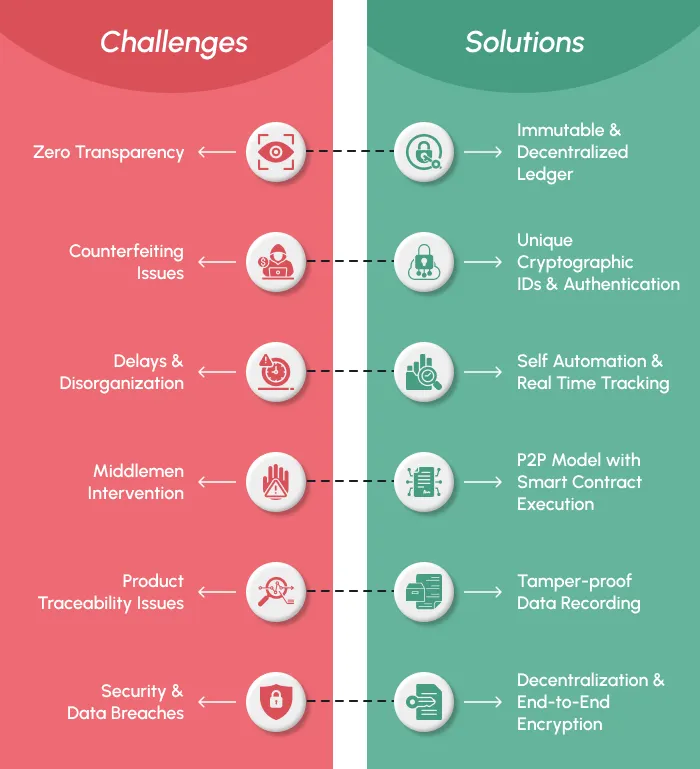
Challenge 1: Lack of Transparency
Supply chain management involves many parties, from raw material suppliers and manufacturers to logistics firms and retailers, each keeping its own data. Those silos create doubt and trust issues. Poor transparency leads to disputes and makes product tracking a hassle, and it hides unethical practices such as hidden markups, substitution with low-quality materials and forced labour in upstream tiers.
How Can Blockchain Fix Transparency Issues in Supply Chains?
By recording events on a shared, permissioned ledger, each authorised participant writes its own updates and reads the same history. This removes data silos, reduces disputes and gives end-to-end product tracking.
-
Tamper-evident supply chain log: every transaction and update is time-stamped and cannot be quietly edited, so all parties see the same verified data.
-
Ethical sourcing checks: smart contracts can require certificates (organic, fair trade, conflict-free) before a batch moves to the next stage.
Challenge 2: Fraudulent Activities
Counterfeiting is a known problem in global trade, especially in pharmaceuticals, electronics and luxury goods. Weak authentication lets fake products enter the market, and buyers struggle to tell genuine products from fakes.
How Can Blockchain Detect and Mitigate Fraud in Supply Chains?
Each product or batch gets a unique digital identity, linked to a QR code, NFC tag or serial number, so authenticity can be checked instantly. Smart contracts can flag suspicious events, such as one serial number scanned in two countries on the same day.
-
Decentralized verification: participants record and verify events independently, which prevents one party from inserting fake records.
-
AI-powered analytics: blockchain data combined with AI tools can spot unusual patterns and rate suppliers on history, complaints and fraud attempts.
Challenge 3: Inefficiencies and Delayed Operations
Global supply chains still depend on paper documents, email approvals and manual checks. A delay in one link ripples through the chain, causing stock shortages, missed deadlines and frustrated customers.
How Does Blockchain Speed Up Supply Chains?
Smart contracts execute steps automatically when coded conditions are met, which reduces manual paperwork. IoT sensors feeding a blockchain give live tracking and fewer surprises.
-
Faster cross-border payments: regulated stablecoins can settle supplier payments in minutes instead of days, without currency-conversion delays. Pixel's guide to blockchain in fintech covers how banks and card networks now use these rails.
-
Shared inventory view: partners see the same stock and shipment data at the same time, which helps prevent shortages and overstocking.
Challenge 4: Costly Intermediary Involvement
Supply chains involve many intermediaries, each taking a fee and adding processing time. That raises product costs and slows the process.
How Does Blockchain Save Your Budget in Supply Chains?
Blockchain can remove some verification and reconciliation steps by giving parties one agreed record, and smart contracts can replace manual checks on invoices and documents.
-
Automated compliance records: audits and paperwork are expensive. A tamper-evident event log makes compliance evidence easier to produce for regulators and customers.
-
Waste reduction: faster, precise traceability means recalls can target only the affected batches, saving cost and product.
Challenge 5: Limited Traceability
Traditional systems lack a unified tracking mechanism, so it is hard to trace raw materials or verify that products were ethically sourced, properly handled or legally transported. This is dangerous when contaminated or defective goods slip through unnoticed, as the 2018 outbreak showed.
How Does Blockchain Enhance Product Traceability in Supply Chains?
Blockchain provides a single, tamper-evident record of a product's journey from raw material to sale. If an issue arises, faulty goods can be traced and recalled quickly, which limits disruption and protects consumer trust.
-
Product authentication: from raw material sourcing to distribution, each step is recorded and can be checked, including by the end consumer through a QR code.
-
Automated alerts: smart contracts can trigger alerts when a shipment leaves its temperature range or deviates from its expected route.
Challenge 6: Data Alteration
Most supply chain records sit in centralized databases, which are targets for cyberattacks and insider manipulation. A single breach can expose or alter sensitive data, and internal fraud, such as falsified inventory records, can go unnoticed.
How Can Blockchain Strengthen Data Security in Supply Chains?
Blockchain's distributed design and cryptographic signatures make unauthorised changes easy to detect. Every transaction is time-stamped and signed, so changes after the fact are visible.
-
MFA and SSI integration: combining blockchain with multi-factor authentication and self-sovereign identity ensures only authorised users write to the ledger.
-
Unique hashing: even a tiny change to a record produces a completely different cryptographic hash, so alterations are instantly detectable.
It is worth being precise: blockchain guarantees that recorded data has not changed, not that it was true when entered. A supplier can still record a false certificate, which is why IoT sensors, audits and trusted data sources remain essential.
Industrial Application of Blockchain Technology in Supply Chain Management
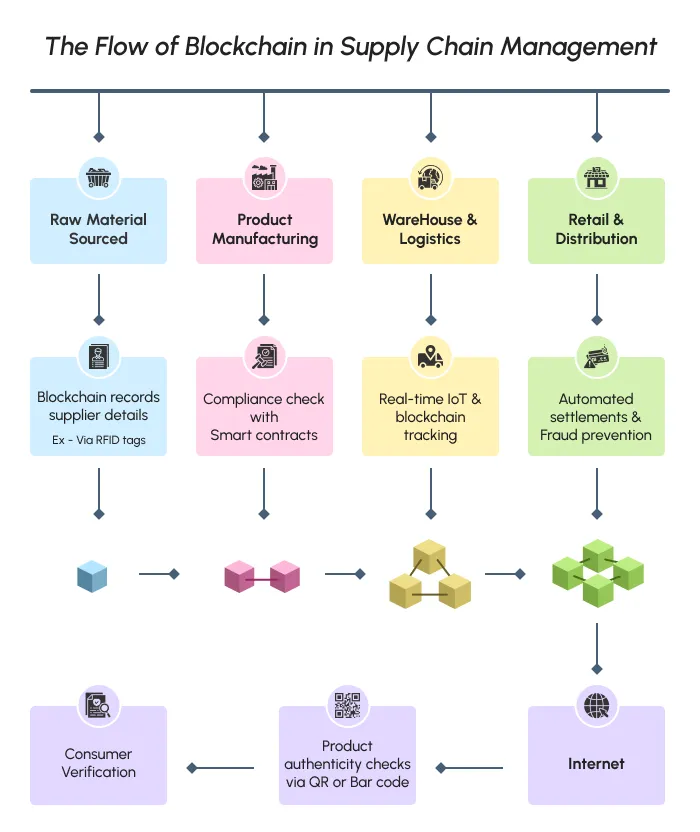
E-Commerce
E-commerce brands juggle inventories, complex supplier networks and customer expectations of fast, reliable delivery. Blockchain improves product traceability, automates payment on delivery and supports authenticity checks for marketplace sellers.
Pharmaceuticals and Health Care
Pharma supply chains must stop counterfeit and diverted medicines. In the US, the Drug Supply Chain Security Act's enhanced tracing rules took effect in November 2023, and in August 2026 the FDA extended the exemption for small dispensers to 27 November 2027. The law requires interoperable electronic tracing, not blockchain specifically, but several industry networks have used blockchain for credential checks and chargeback contracts.
Agri and Food Supply Chain
Blockchain supports food safety by tracking produce from farm to store, verifying organic and fair-trade claims and cutting recall times. Consumers can scan a QR code to check origin and dates. Carrefour reported that products it tracked on a blockchain, such as chicken and grapefruit, sold better than their untracked equivalents.
Logistics Management
Blockchain reduces paperwork, supports digital bills of lading and customs documents, and automates freight invoice checks. Walmart Canada's freight network, described below, is the clearest proof.
Luxury Goods and Diamonds
You don't have to trace your fingers across the stitches of a designer bag to know whether it is real. Blockchain-based product passports let brands and buyers authenticate bags, watches, jewellery and diamonds, and support resale markets with a verified history.
Defense and Aerospace
Defense and aerospace supply chains need tamper-evident records of part origins and maintenance history. Blockchain can help verify that components are genuine, reduce counterfeit parts and support audits in government procurement.
As these industries adopt blockchain, some deployments already show measurable results.
Also Read: Top 8 Use Cases of Blockchain Technology Across Industries
Real-World Examples of Blockchain in Supply Chain Management
These are deployments with published results, not just announcements. Note that platforms such as Audius (music streaming) and Propy (real estate transactions), sometimes listed in supply chain articles, are blockchain products in other sectors.
| Deployment | What it tracks | Published result | Status |
|---|---|---|---|
| Walmart food traceability (Hyperledger Fabric) | Mangoes, pork, leafy greens | Traceback from about 7 days to 2.2 seconds | Results from 2018 to 2019 trials |
| Walmart Canada DL Freight (DLT Labs) | Carrier invoices and payments | Disputes from about 70% to under 2% across about 60 carriers | Rolled out from 2019 |
| De Beers Tracr | Rough diamonds from mine to market | More than 5 million rough diamonds registered | Live; GIA took a 30% stake in May 2026 |
| Carrefour | Chicken, grapefruit and about 20 product lines | Higher sales for tracked products | Ran on IBM's platform |
| Nestlé with OpenSC | Milk and palm oil sourcing | Pilot announced in 2019 | No later results published |
MediLedger, often listed for pharma tracking, is now marketed by Chronicled mainly for contracts and chargebacks; check current scope before citing it as a tracing network.
What Happened to IBM Food Trust and TradeLens?
Two of the best-known blockchain supply chain platforms did not survive, and their lessons matter more than any success story.
TradeLens (Maersk and IBM). Launched in 2018 to digitise shipping documents, TradeLens was closed after Maersk said the platform did not reach commercial viability because "the need for full global industry collaboration has not been achieved", in its November 2022 announcement. It went offline by the end of the first quarter of 2023.
IBM Food Trust. Walmart, Carrefour and Nestlé all piloted on IBM's food traceability network. IBM has since withdrawn its Food Trust-family Blockchain Transparent Supply cloud service, in 2025, and the old product pages now redirect.
Everledger. The diamond and luxury-provenance startup went into voluntary administration in April 2023 after an investor failed to pay a funding tranche.
The lessons:
- A single company's platform struggles to win rivals. Competing carriers did not want to put their data on a platform run by Maersk.
- The network effect is the product. A ledger with five participants adds little; value appears only when most of the chain joins.
- Business models beat technology. De Beers' Tracr survives because De Beers controls a large share of supply and can require participation.
The EU Digital Product Passport Timeline
The EU's Ecodesign for Sustainable Products Regulation, Regulation (EU) 2024/1781, entered into force on 18 July 2024. It creates Digital Product Passports: a data carrier (such as a QR code) on each product linking to information on materials, repairability, recycled content and compliance.
| Milestone | Date | What happens |
|---|---|---|
| ESPR enters into force | 18 July 2024 | Framework for product passports established |
| Ecodesign working plan | April 2025 | Commission prioritises products such as steel, aluminium, textiles, tyres and furniture |
| Central DPP registry | Due by 19 July 2026, now launched | EU registry of passport identifiers; product data itself stays with companies |
| Battery passport | 18 February 2027 | Mandatory for EV, light-transport and industrial batteries over 2 kWh under the Batteries Regulation |
| First product delegated acts | From 2027 onwards (expected) | Passport rules for priority product groups phase in, each with its own deadline |
Does the Digital Product Passport require blockchain? No. The rules set data and access requirements and leave the technology to companies. Blockchain is one option for proving that passport data has not been altered and for linking events across many suppliers; a well-run database with digital signatures is another. The decision framework below helps you choose.
Does Your Supply Chain Need Blockchain? A Decision Framework
Many supply chain projects fail because a database would have done the job. Ask these six questions. The more "yes" answers, the stronger the case for blockchain.
| Question | If yes | If no |
|---|---|---|
| 1. Do several independent companies need to write to the same record? | Blockchain fits | A shared database or EDI is enough |
| 2. Is there no single party everyone trusts to run the system? | Blockchain fits | Let the trusted party host a database |
| 3. Do records need to be verifiable by outsiders (regulators, consumers, auditors)? | Blockchain or signed records fit | Internal database is enough |
| 4. Will payments or ownership move automatically when events happen? | Smart contracts add value | Workflow software is enough |
| 5. Can you get most of your partners to join? | Network effects will appear | Expect a TradeLens outcome |
| 6. Is tampering or counterfeiting a costly, proven problem? | The investment can pay back | The benefit may not cover the cost |
A simple scoring rule: four or more "yes" answers make a strong case for a permissioned blockchain such as Hyperledger Fabric or an enterprise network anchored to a public chain. Two or three suggest a pilot with your most important partners. One or none means you should improve your existing systems first. Pixel's guide to blockchain integration for business explains how to connect a ledger to existing ERP and warehouse systems if you go ahead.
Future Possibilities of Blockchain in Supply Chain Management
Blockchain in supply chain management could have a large influence on global trade networks. Here is where the most credible growth is.
Regulatory product passports. The EU's battery passport (2027) and later product passports will force companies to share verified product data with customers and authorities. Where many suppliers contribute data, a shared ledger can prove the history has not changed.
Tokenized trade finance. Businesses could use tokens to represent goods in transit or warehouse inventory, so lenders can finance them faster with live proof of where the goods are. Tokenized deposits and regulated stablecoins now give this a real settlement layer.
AI with trusted data. AI agents that reorder stock or route shipments need data they can trust. Blockchain-anchored events give them a verified history, and smart contracts can execute payments and compliance checks automatically.
Interoperability and post-quantum security. Standards for linking different ledgers, and signature schemes that resist future quantum computers, are maturing, which will make networks more adaptive and longer-lived.
Market research firms expect strong growth. IMARC estimates the blockchain supply chain market at about $1.64 billion in 2025 and forecasts about $35 billion by 2034, though forecasts in this market vary widely between firms.
Challenges of Integrating Blockchain in Supply Chain Management Systems
Businesses must navigate several challenges before they see the benefits. Here are the most common.
Costly Solutions
Blockchain needs investment in development, integration, node hosting and maintenance, plus onboarding costs for every partner. Pixel Web Solutions quotes an enterprise proof of concept from $20,000 and blockchain applications from $25,000 to $150,000, depending on the number of partners, integrations and IoT devices.
Complex Adoption
Many supply chain participants, especially small suppliers, lack the skills to run blockchain systems. Adoption needs simple apps, training and incentives, or partners will keep using email and spreadsheets.
Integration with Existing Systems
Most supply chains rely on ERP, warehouse management and EDI systems. Connecting them to a ledger takes careful API and data-mapping work; without it, companies gain complexity instead of efficiency.
Scalability Issues
Supply chains generate huge volumes of events. Storing every sensor reading on-chain is slow and expensive, so good designs keep raw data off-chain and anchor batches of hashes on-chain.
Lack of Standardization and Partner Buy-in
There is no single blockchain standard for supply chains, and different companies use different platforms. The bigger barrier is governance: who runs the nodes, who pays, and who owns the data. TradeLens shows that without broad buy-in, even well-funded networks close.
Power Up Your Supply Chain Management Systems With Pixel Web Solutions!
To sum up, blockchain in supply chain management is not a fleeting trend, but it is not a universal fix either. It solves traceability, counterfeiting and multi-party reconciliation where several companies need one trusted record, and it fails where partners won't join or a database would do. Different businesses face different problems, so they need different models, which makes implementation tricky without the right expertise.
That is why working with an experienced enterprise blockchain development company like Pixel Web Solutions can make the difference. Pixel's team of blockchain experts and industry analysts helps businesses score the use case, design the network and governance, and build the platform, whether on Hyperledger Fabric or a public chain. As a blockchain software development company, Pixel also builds the smart contracts that automate payments and compliance, as described in its guide to smart contract use cases.
Blockchain tech isn't just a solution, it is the key to levelling up your business! Talk to Pixel's team about blockchain in supply chain for your products.
Frequently Asked Questions
How is blockchain used in supply chain management?
To record product movements, documents and certificates on a shared ledger, so every partner sees the same history; to authenticate products against counterfeits; and to automate payments and checks with smart contracts.
What is the best example of blockchain in supply chain?
Walmart's food traceability trials (a 7-day mango traceback cut to 2.2 seconds) and De Beers' Tracr, with more than 5 million rough diamonds registered, are the best-known examples. Walmart Canada's freight invoice network is the clearest smart contract example.
Why did IBM Food Trust and TradeLens fail?
Not enough of the industry joined. Maersk said TradeLens did not reach commercial viability because full global industry collaboration was not achieved. Supply chain ledgers only create value when most partners use them.
Does the EU Digital Product Passport require blockchain?
No. The rules are technology-neutral: they define what data must be available and to whom. Blockchain is one way to prove passport data has not been altered, but not a legal requirement.
What are the disadvantages of blockchain in supply chain?
Setup and integration costs, the need to onboard many partners, scalability limits for high-volume data, a lack of common standards, and the fact that a blockchain cannot verify that data was true when it was entered.
How much does a blockchain supply chain solution cost?
Pixel Web Solutions quotes enterprise proofs of concept from $20,000 and blockchain applications from $25,000 to $150,000, depending on partners, integrations and IoT hardware.