









AI trading bot development is the process of building software that uses machine learning, live market data and automated execution to find trades and place orders on exchanges or brokers, inside strict risk limits. A sound build combines clean data, a validated model, a separate risk layer, secure exchange APIs and honest backtesting. Professionally built single-strategy bots start from $6,000 with Pixel Web Solutions, and the hardest part is proving the strategy works out of sample, not writing the code.
Every second, financial markets generate thousands of price movements, trading signals and market events. Processing this volume manually is impossible, and traditional rule-based trading systems often struggle when market conditions change.
This is why AI trading bots have become a strategic investment across the financial industry. Using artificial intelligence, machine learning and predictive analytics, these systems let businesses automate trading decisions, execute faster and respond to market opportunities as they happen. At the same time, regulators warn that AI will not turn trading bots into money machines, so the way a bot is built, tested and marketed matters as much as the model inside it.
In this guide, you will learn how AI trading bots work, the technologies behind them, their types and features, the leading AI trading bots in 2026, why most backtests mislead, and the step-by-step process of AI trading bot development for your business.
Key Takeaways
- An AI trading bot adds learning to automation. It uses machine learning on price, order book and news data to generate signals, then executes through exchange or broker APIs within risk limits.
- Backtests flatter AI models. Test 100 strategy variants on two years of data and the best one will show an annualised Sharpe ratio near 1.8 by luck alone, so validation design is the core of the build.
- Risk is a separate layer. Position limits, stop rules and a kill switch must sit outside the model, so a bad prediction cannot become a catastrophic loss.
- Claims are regulated. US regulators have fined firms for "AI washing" and warned the public about AI trading bot scams; marketing must match what the bot actually does.
- Costs start at $6,000. Pixel Web Solutions builds single-strategy bots from $6,000 in 6 to 10 weeks; multi-strategy systems and SaaS platforms take longer and cost more.
What Is an AI Trading Bot?
An AI trading bot is a software program that uses artificial intelligence (AI), machine learning (ML) and live market data to find trading opportunities and place buy or sell orders automatically. Unlike traditional rule-based bots, which follow fixed instructions such as "buy when the 50-day average crosses the 200-day average", an AI trading bot learns patterns from historical prices, market trends, technical indicators, order flow and even news. As a result, traders and businesses can identify opportunities and manage risk at a scale no human desk can match.
How It Works
AI trading bots work in a clear, logical cycle:
- Collect data: real-time prices, order books and trades from exchanges and financial APIs, plus news or on-chain data.
- Build features: turn raw data into model inputs such as returns, volatility, spreads and sentiment scores.
- Predict: the model estimates the probability or size of a price move.
- Check risk: a separate risk engine applies position limits, exposure caps and stop rules.
- Execute: orders go to the exchange through secure APIs, with smart order routing where needed.
- Monitor and retrain: results are logged, performance is tracked, and models are retrained on a schedule when data shifts.
The model never acts alone. In a well-built bot, the risk layer can always overrule the model.
Core Technologies Powering AI Trading Bots
An AI trading engine combines several technologies. Each one plays a specific role in analyzing markets, forecasting, managing risk and executing trades.
- Artificial Intelligence
AI is the decision engine, processing large volumes of market data, identifying opportunities and making decisions without constant human input.
- Machine Learning
ML models, such as gradient-boosted trees and neural networks, learn from past market activity and adjust as conditions change. In practice, simpler models with strong validation often beat complex ones.
- Deep Learning
Deep learning finds non-linear relationships in complex data, such as order book dynamics or multi-asset patterns. It needs much more data and is more prone to overfitting, so it suits teams with large, clean datasets.
- Big Data Analytics
Every trading day produces millions of price updates and transactions. Big data pipelines store, clean and process this information in real time.
- Generative AI
Generative AI creates summaries, strategy explanations and personalized insights from complex market data, which improves the user experience on trading platforms.
- AI Agents
AI agents can research markets, propose strategies and run workflows with limited human input. For live trading, agents should act only within hard-coded risk limits and approval rules.
- Large Language Models
LLMs read financial news, filings and research and answer natural language questions, which powers conversational market intelligence and trading assistants.
- Cloud Computing
Cloud infrastructure provides the scalable compute, storage and uptime an AI trading bot needs, with servers placed close to exchanges where latency matters.
- Natural Language Processing
Markets often react to news before charts move. NLP lets AI trading bots score financial news, earnings reports, regulatory announcements and social media for sentiment.
- Predictive Analytics
Predictive analytics combines historical and real-time data to estimate future price movements, entry and exit points, and expected profit or loss per trade.
- Reinforcement Learning
Reinforcement learning trains a bot through trial and feedback, usually in a simulator. It is powerful but fragile: a policy that learns a simulator's quirks can fail in live markets, so it needs especially careful testing.
For businesses developing AI trading platforms, the right technology stack directly affects accuracy, performance and long-term competitiveness.
Types of AI Trading Bots
Here are the main types of AI trading bots.
1. Arbitrage Bots
Arbitrage bots exploit price differences for the same asset across exchanges, buying where it is cheaper and selling where it is dearer at the same time. Margins are thin and competition is intense, so fees, transfer times and latency decide whether arbitrage is profitable; it is lower-risk, not risk-free.
2. Trend-Following Bots
Trend-following bots use historical prices and technical indicators to detect bullish or bearish trends. They suit medium-term to long-term strategies and tend to lose money in sideways markets.
3. Multi-Agent Trading Bots
Several AI agents collaborate: one analyzes the market, one evaluates risk, one selects the strategy and one executes. This design suits enterprise and institutional trading systems.
4. Market-Making Bots
Market-making bots provide liquidity by placing both buy and sell orders and earning the bid-ask spread. Crypto exchanges, liquidity providers and institutions use them.
5. Grid Trading Bots
Grid trading bots place multiple buy and sell orders across a predefined price range, capturing regular price swings without predicting direction. They perform best in ranging markets.
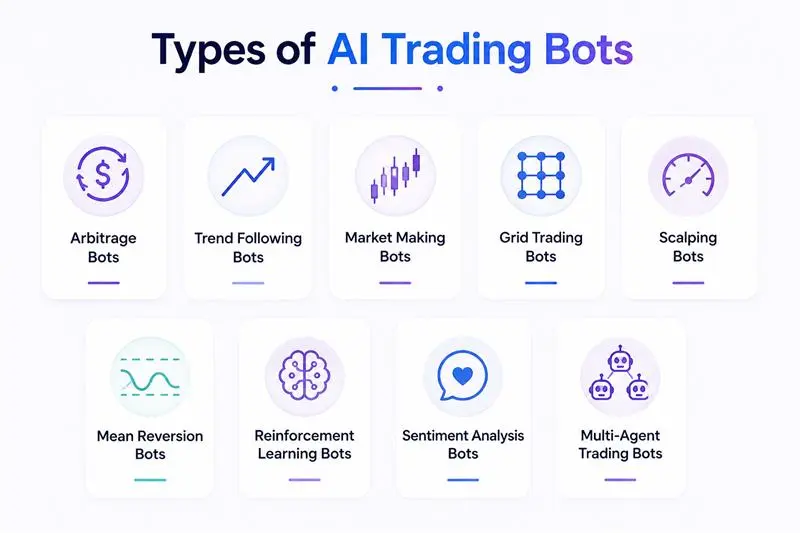
6. Scalping Bots
Scalping bots place a high volume of short-term trades to capture small price movements. They suit high-frequency traders, but fees and slippage can erase their edge quickly.
7. Mean Reversion Bots
Mean reversion bots identify assets that have moved far from their historical average and bet on a return to that average. They can perform well in volatile, over-extended markets, but suffer when a trend persists.
8. Reinforcement Learning Bots
These bots learn a trading policy through reinforcement learning, adapting to changing market conditions. They require large amounts of simulated and historical data and rigorous out-of-sample testing.
9. Sentiment Analysis Bots
Sentiment analysis bots use natural language processing to read news, social media and market sentiment, aiming to act before price moves appear on charts.
Enterprise AI trading platforms often combine several of these strategies into one integrated system that serves different user needs.
Significant Features of AI Trading Bots
The features of an AI trading bot define its performance, accuracy and scalability. Here are the features that help businesses deliver smarter, faster and more reliable trading.
- AI-Based Trading Engine: analyzes market prices in real time and trades automatically based on model signals.
- AI Copilot: gives AI-driven market insights and customized trading suggestions.
- Multi-Exchange Integration: trades across several exchanges or brokers from one platform.
- Automated Portfolio Management: tracks portfolios and rebalances them to match trading objectives.
- Risk Management: enforces stop-loss limits, take-profit limits, position sizing, exposure caps and a kill switch.
- Backtesting: tests strategies on historical data, including fees and slippage.
- Walk-Forward Validation: retests the strategy on rolling, unseen periods to catch overfitting.
- Paper Trading: runs strategies live without real money before funding.
- Predictive Market Analytics: forecasts likely market moves from historical and live data.
- Smart Notifications: sends instant alerts on price movements, trade executions and risk events.
- Enterprise-Grade Security: encryption, 2FA, IP whitelisting and trade-only API keys with withdrawals disabled.
- Sentiment Analysis: scores news and social media reactions before they affect prices.
- Audit Logs: records every signal, order and override for compliance and debugging.
Build an AI Trading Bot That Sets Your Platform Apart
Talk to our experts today and build an AI trading bot that is smarter and delivers sustainable business growth
Main Advantages of AI Trading Bots
AI trading bots move trading from basic automation to data-driven decision-making. Here are the benefits, along with the honest limits.
- Faster Execution: AI trading bots execute in milliseconds, reducing slippage and capturing time-sensitive opportunities.
- Emotion-Free Decisions: decisions follow data and rules, removing fear, greed and human bias from execution.
- 24/7 Automated Trading: bots monitor global markets around the clock, which matters especially in crypto.
- Richer Signals: models can combine price, order book, on-chain and news data that no human could track at once.
- Consistent Risk Management: risk rules apply to every trade, every time.
- Scalable Trading Operations: one platform can run many strategies, markets and users.
- Reduced Operational Overhead: automation cuts manual work and manual errors.
- New Revenue Opportunities: exchanges, brokers and fintechs can offer bots to users as a premium feature.
The limits are just as important. AI does not guarantee profit, models degrade when markets change, and a bot can lose money faster than a human. That is why validation and risk controls, covered below, are the heart of building an AI trading bot.
AI Trading Bots vs Traditional Trading Bots
While both AI trading bots and traditional trading bots automate trading, their capabilities differ significantly.
| Aspect | AI Trading Bots | Traditional Trading Bots |
|---|---|---|
| Decision-making | Model-driven and adaptive | Rule-based and predefined |
| Learning capability | Learns from market data through retraining | Needs manual rule updates |
| Market analysis | Historical, real-time, order book and sentiment data | Fixed technical indicators |
| Strategy optimization | Adjusts parameters as data changes | Follows static rules |
| Transparency | Harder to explain individual decisions | Every decision is traceable to a rule |
| Overfitting risk | High, needs strict validation | Lower, fewer parameters |
| Risk management | Model-informed plus hard-coded limits | Rule-based limits |
| Build and running cost | Higher: data, training, monitoring | Lower |
| Best suited for | Businesses seeking adaptive, multi-asset strategies | Simple automated strategies |
AI trading bots can deliver more adaptive results, but only when the extra complexity is matched by stronger testing and monitoring.
Why Most AI Trading Bot Backtests Mislead (and the Maths to Prove It)
This is the section most AI trading bot guides leave out, and it decides whether a bot makes or loses money. AI development tests many model versions, features and settings. Each test is another chance for luck to look like skill.
Researchers David Bailey and Marcos López de Prado quantified this in The Deflated Sharpe Ratio. If you run N independent strategy tests that have no real edge, the best one will still show an impressive Sharpe ratio (return per unit of risk) purely by chance. The expected best result is approximately:
Expected maximum Sharpe ≈ (standard error) × [(1 – γ) × Z(1 – 1/N) + γ × Z(1 – 1/(N × e))]
where γ is the Euler-Mascheroni constant (about 0.5772), Z is the inverse of the standard normal distribution, and e is Euler's number. For a strategy with no edge, the standard error of an annualised Sharpe ratio is roughly 1 divided by the square root of the years of data.
Here is what that means in practice, with every strategy having zero true edge:
| Strategy variants tested (N) | Multiplier | Best Sharpe with 1 year of data | With 2 years | With 5 years |
|---|---|---|---|---|
| 10 | 1.58 | 1.58 | 1.11 | 0.70 |
| 100 | 2.53 | 2.53 | 1.79 | 1.13 |
| 1,000 | 3.26 | 3.26 | 2.30 | 1.46 |
For example, with 100 variants and 2 years of data: 2.53 × (1 ÷ √2) = 2.53 × 0.707 = 1.79. A Sharpe ratio of 1.8 looks like an excellent strategy, yet here it is pure noise. Hyperparameter searches in machine learning can run thousands of variants without anyone counting them.
To build an AI trading bot that survives live markets:
- Count every trial. Log every model, feature set and parameter tested, and judge the winner against the expected maximum for that count, not against zero.
- Hold out data you never touch. Keep a final test period the model has never seen, and use it once.
- Use walk-forward testing. Train on one period, test on the next, roll forward, and report the combined out-of-sample results.
- Include real costs. Fees, spreads, slippage and funding rates often turn a paper profit into a loss.
- Paper trade before funding. Run the bot live without money for weeks, then start with small capital and hard loss limits.
This discipline is what separates a bot that looks good in a pitch deck from one that works with real money.
Best AI Trading Bots in 2026
The rapid adoption of AI has produced many AI trading platforms for different needs. Here are some well-known AI trading bots and tools in 2026. They are listed for context, not as investment recommendations.
Trade Ideas (for stocks)
Trade Ideas is a US stock scanning and trading platform whose AI system, "Holly", generates daily trade ideas, alongside real-time scanning and automated strategy execution for active traders.
Pionex (for crypto)
Pionex is a crypto exchange with built-in trading bots, including grid, DCA and rebalancing bots, so users can automate trading without a third-party tool. Recent reviews count around 16 free built-in bots.
TrendSpider (for technical analysis)
TrendSpider automates technical analysis, trendline detection, pattern recognition and strategy backtesting, so traders can make faster, more informed decisions.
Tickeron
Tickeron is an AI-powered pattern recognition and analytics platform whose "AI Robots" generate trading signals across stocks, ETFs, forex and crypto.
Coinrule (for no-code strategy creation)
Coinrule is a no-code crypto automation platform where users build rule-based "if this, then that" strategies and connect them to exchanges. It is closer to a traditional rule-based bot than a learning AI system.
These platforms serve individual traders. Businesses, however, increasingly build custom AI trading bots to own their strategies, data, branding, compliance controls and revenue, which is driving demand for custom bot development rather than off-the-shelf tools.
AI Trading Bot Use Cases Across Industries
AI trading bots have moved beyond individual trading tools to become strategic assets across the financial ecosystem. Here is how different industries use them.
- Crypto Exchanges
Crypto exchanges use AI trading bots to provide liquidity, offer automated trading to users, and keep customers engaged with copy-trading and strategy marketplaces.
- DeFi Trading Platforms
DeFi platforms use bots for on-chain trading, liquidity management, arbitrage and yield automation across decentralized protocols.
- Stock Brokerages
Brokerages use AI-powered assistants to help investors make decisions, optimize portfolios and receive personalized insights.
- Forex Platforms
Forex platforms use AI trading bots to monitor currency markets in real time and execute based on economic data and price action.
- Hedge Funds
Hedge funds use AI-driven predictive analytics and algorithmic execution to find opportunities and manage portfolio risk.
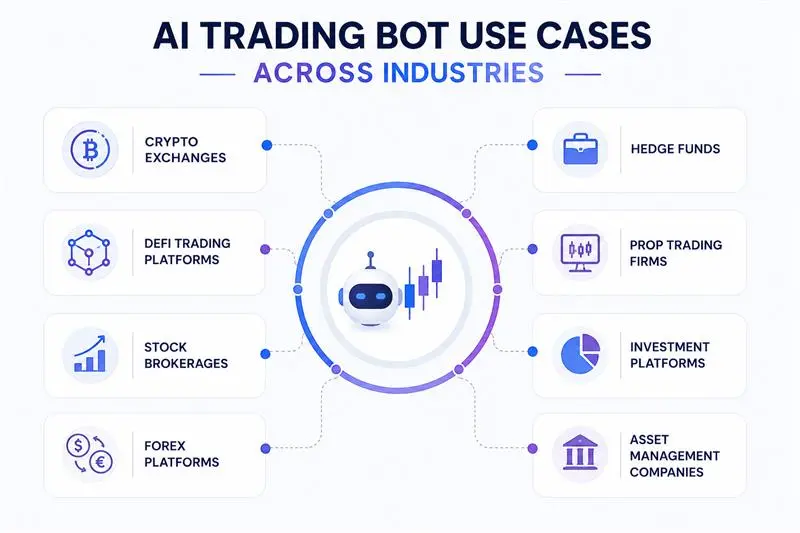
- Prop Trading Firms
Proprietary trading firms use AI-based bots to run high-frequency and data-driven strategies faster and more consistently than manual trading.
- Investment Platforms
Investment platforms use AI to automate portfolio management, risk assessment and market analysis for retail and institutional clients.
- Asset Management Companies
Asset managers use AI to support allocation decisions and manage diversified portfolios efficiently.
Businesses that adopt AI trading bots responsibly are better positioned to automate intelligently, improve customer experience and build a lasting competitive advantage.
Launch Your AI Trading Platform with Confidence
Take the first step toward launching a secure, scalable, and market-ready AI trading platform. Connect with our AI experts today.
Step-by-Step Blueprint to Build an AI Trading Bot
AI trading bot development requires more than coding an algorithm. It needs a strategic combination of data, models, trading logic, market integrations, risk controls and security. The detailed coding walkthrough lives in the guide on how to build a crypto trading bot; here is the blueprint for an AI-driven system.
- Business Requirement Analysis
Define the target market, asset classes, users, trading strategy and objectives, plus the regulatory status of the product (proprietary tool, user-facing bot or managed service).
- Data Sourcing and Engineering
Secure reliable historical and live data: prices, order books, trades, funding rates, news or on-chain data. Clean it, align timestamps and remove survivorship and look-ahead bias.
- Selecting the AI Models
Choose models that fit the data and strategy. Start with simple, explainable baselines, then add complexity only when it beats them out of sample.
- Designing the Trading Architecture
Build a scalable, low-latency architecture that separates data, signal, risk and execution services, so each can be tested and replaced independently.
- Developing Trading Algorithms
Turn model outputs into trading rules: entry and exit logic, position sizing and order types.
- Exchange API Integration
Use official exchange and broker APIs or a maintained library such as CCXT for crypto venues. Respect rate limits and use trade-only keys with withdrawals disabled.
- AI Model Training and Validation
Train on historical data, validate with walk-forward testing, and keep an untouched hold-out period. Log every trial so you can apply the multiple-testing check above.
- Backtesting and Simulation
Backtest with realistic fees, spreads and slippage, then stress-test the strategy against crashes, gaps and exchange outages.
- Risk Layer and Security Implementation
Build the risk engine as a separate service with position limits, daily loss limits and a kill switch. Add encryption, secure key storage, multi-factor authentication and audit logs.
- Paper Trading, Testing and Deployment
Run functional, security and performance tests, then paper trade before funding. Go live with small capital and staged limits.
- Continuous Monitoring and Retraining
Monitor live performance against the backtest, detect model drift, and retrain or retire models on a defined schedule.
Regular model improvements, performance monitoring and strategy reviews keep your AI trading bot competitive, accurate and scalable in changing markets.
Regulation and Claims: A Checklist Before You Launch
AI trading bots attract regulatory attention, both for how they trade and for how they are marketed. Use this checklist before launch; it is not legal advice.
- Do not overstate the AI. In March 2024, the US SEC fined two investment advisers, Delphia and Global Predictions, a combined $400,000 for "AI washing", meaning false claims about their use of AI.
- Never promise returns. The CFTC's customer advisory warns that claims of guaranteed or extremely high returns from AI bots are red flags of fraud, and cites a scheme that took more than $1.7 billion in bitcoin from at least 23,000 people.
- Supervise your algorithms. For US broker-dealers, FINRA Regulatory Notice 15-09 sets expectations for supervising and testing algorithmic trading strategies.
- Meet EU algorithmic trading rules. Investment firms trading algorithmically in the EU must meet the organisational and testing requirements in Commission Delegated Regulation (EU) 2017/589 (RTS 6), and crypto service providers fall under MiCA.
- Check UAE licensing. In Dubai, virtual asset broker-dealer and management services are licensed by VARA; securities trading services fall under the SCA onshore or the DFSA in the DIFC.
- Follow exchange API terms. Respect rate limits, market-abuse rules and any restrictions on running bots for third parties.
The rules depend on who owns the money. A bot that trades only a firm's own capital faces far fewer obligations than one that trades for customers or sells signals.
How Much Does AI Trading Bot Development Cost?
Pixel Web Solutions builds a single-strategy trading bot from $6,000, including a proper risk layer. Multi-strategy systems and customer-facing trading bot SaaS platforms cost substantially more, and AI model development, data subscriptions and retraining add to the budget. For a full breakdown by feature and development stage, see the guide to the cost to build an AI trading bot.
Based on Pixel Web Solutions' published delivery timelines:
| Scope | Typical timeline |
|---|---|
| Single-strategy bot, specification to paper trading | 6 to 10 weeks |
| Multi-strategy trading system | 12 to 20 weeks |
| Trading bot SaaS platform | 16 to 24 weeks |
Budget separately for market data, hosting and ongoing maintenance, which are monthly costs.
How to Choose an AI Trading Bot Developer
Use this scorecard when comparing providers:
- Validation honesty: do they show out-of-sample and walk-forward results, and count their trials?
- Risk architecture: is the risk engine separate from the model, with a kill switch?
- Security: trade-only API keys, secure secret storage and audit logs as standard.
- Market experience: have they integrated your exchanges, brokers and asset classes before?
- Compliance awareness: can they build supervision, logging and controls for your regulatory status?
- Ownership and support: do you own the code and models, and is monitoring and retraining included after launch?
Pixel Web Solutions: Your Reliable AI Trading Bot Partner
Pixel Web Solutions is an AI and ML development services provider with strong expertise in artificial intelligence, crypto and Web3. As a crypto trading bot development company, it builds AI-powered trading bots that help businesses automate trading, improve decision-making and grow, each one tailored to the client's strategy and long-term goals.
Pixel's team handles the full development lifecycle under one roof: strategy and risk specification, data and honest backtesting, build and integration, paper trading and hardening, then funded deployment and handover. Its bots are designed to process real-time market data, support high trading volumes and scale with the business.
Whether you are launching a new AI trading platform or upgrading an existing one, Pixel Web Solutions can help you build a secure, scalable and well-tested AI trading bot. Talk to the Pixel Web Solutions team to get your strategy stress-tested before you fund it. Good AI trading bot development starts with honest validation, and that is where Pixel starts.
Build the next generation of intelligent trading solutions with Pixel Web Solutions.
Frequently Asked Questions
Can AI trading bots trade multiple asset classes?
Yes. AI trading bots can be developed for cryptocurrencies, stocks, forex, commodities, ETFs, options and futures through multi-market and multi-exchange integrations. Each asset class adds data, integration, testing and regulatory work.
How much does AI trading bot development cost?
Pixel Web Solutions builds a single-strategy trading bot from $6,000. Multi-strategy systems, AI model development, multiple exchange integrations and SaaS platforms with user dashboards cost more, depending on scope. Data, hosting and maintenance are ongoing monthly costs.
How long does it take to develop an AI trading bot?
A single-strategy bot takes 6 to 10 weeks from specification to paper trading, a multi-strategy system 12 to 20 weeks, and a trading bot SaaS platform 16 to 24 weeks. Data preparation and honest backtesting usually take longer than writing the strategy.
Are AI trading bots profitable?
Some are, many are not. Profitability depends on a real, validated edge, low costs and strong risk control, not on the AI label. Be wary of any bot that promises guaranteed or very high returns, which US regulators describe as a red flag of fraud.
Are AI trading bots legal?
Yes, using a trading bot to trade your own money is legal in most countries, subject to exchange rules. Offering bots, signals or automated trading to customers can require licences, such as investment adviser, broker or virtual asset service provider authorisation, depending on the market.
What is the difference between an AI trading bot and an algorithmic trading bot?
An algorithmic trading bot follows fixed rules written by a person. An AI trading bot uses machine learning to learn or adjust those rules from data. AI bots can adapt more, but they are harder to explain and more prone to overfitting.
Why should businesses choose custom AI trading bot development?
A custom build lets businesses build proprietary strategies, integrate with existing systems, strengthen security, meet their own compliance needs, scale efficiently and keep full ownership of the code, models and data.