AI marketing agent development is the process of building software that plans, executes and optimises marketing tasks on its own, using a large language model for reasoning, tools that connect it to your CRM and ad platforms, memory of your customers and brand, and guardrails that cap spend and require approvals. A focused single-channel agent typically costs about $7,500 to $30,000 to build at offshore rates, while multi-channel agents run from about $20,000 to $80,000, plus monthly model costs that are often under a few hundred dollars.
Modern marketing has become increasingly complex. Teams manage repetitive tasks across many channels while customers expect personalised experiences, instant responses and relevant recommendations at every touchpoint. From email campaigns and social media to lead nurturing and reporting, marketers often spend more time on operations than on strategy.
This is where AI marketing agents are changing the landscape. By automating workflows, analysing customer behaviour and optimising campaigns in real time, these systems help businesses improve efficiency and results. This guide explains what an AI marketing agent does, how its architecture fits together, which real products to learn from, what AI marketing agent development costs, and how to choose a builder.
Key Takeaways
- AI is common, agents are not yet. Salesforce's State of Marketing report finds 75 percent of marketing organisations use AI, but only 13 percent use self-directed agents, so early adopters still have room to stand out.
- Every agent has four parts: an LLM "brain", tools that take action, memory of customers and brand, and guardrails that keep it safe and on budget.
- Real products prove the model works, but results vary: HubSpot reports a 70 percent autonomous resolution rate for its customer agent, while independent tests of Meta's automated ads are mixed.
- Costs are predictable with the maths shown: build effort in hours times an hourly rate, plus model usage per task.
- Compliance is part of the design. FTC rules on fake reviews, TCPA rules on AI voices and EU AI Act transparency duties from August 2026 all affect marketing agents.
What Is an AI Marketing Agent?
An AI marketing agent is an intelligent software system that performs marketing tasks autonomously by analysing data, making decisions and executing actions with minimal human intervention. Unlike traditional marketing tools that follow fixed rules, AI marketing agents use machine learning, natural language processing and large language models to understand customer behaviour and decide what to do next.
They personalise interactions, improve campaigns, create content and improve performance using real-time insights. Acting as virtual marketing assistants, these agents help businesses run complex marketing operations, engage customers and achieve better results across channels.
AI marketing agent vs marketing automation: a marketing automation workflow says "if a lead downloads the e-book, send email 2 after three days". An AI marketing agent is given a goal ("re-engage customers who have not bought in 90 days within a $2,000 budget"), decides which customers, channels, messages and timing to use, executes, measures and adjusts.
Why Are Businesses Investing in AI Marketing Agent Development?
According to Grand View Research, the global AI in marketing market was valued at USD 27.0 billion in 2025 and is projected to reach USD 194.8 billion by 2033, growing at a CAGR of 27.6 percent from 2026. This growth reflects how businesses are investing in AI-powered marketing to automate workflows, personalise customer experiences and optimise campaign performance.
Automate Repetitive Marketing Tasks
Salesforce's 10th State of Marketing report, based on nearly 4,500 marketers, found that 75 percent of marketing organisations use AI in at least one form, and marketers expect AI agents to save them up to eight hours a week. AI marketing agents take over scheduling, monitoring and reporting, so teams can focus on strategy and creativity.
Deliver Personalized Customer Experiences
McKinsey research found that 71 percent of consumers expect personalised interactions and 76 percent get frustrated when they do not receive them. AI marketing agents analyse behaviour in real time to deliver tailored content, recommendations and offers across channels.
Improve Campaign Performance
AI marketing agents continuously adjust audience targeting, messaging and budget allocation based on live performance data. This helps businesses improve conversions and return on ad spend with less manual work, provided results are checked with proper lift tests.
Make Faster, Smarter Decisions
AI marketing agents analyse large volumes of customer and campaign data and recommend the next best action, such as which segment to target or which offer to test next, in minutes rather than days.
Scale Marketing Across Multiple Channels
AI marketing agents manage campaigns across email, social media, websites, search engines and paid advertising, keeping the customer experience consistent while reducing operational complexity.
Gain a Competitive Advantage
Adoption of full agents is still early: Salesforce found that only 39 percent of marketing teams have fully integrated AI and just 13 percent use self-directed agents. Businesses that build reliable agents now can launch campaigns faster and engage customers better than slower competitors.
The rise of AI marketing agents shows that businesses are moving from basic automation to intelligent, autonomous marketing systems.
How AI Marketing Agents Work?
AI marketing agents follow an intelligent workflow to turn raw customer data into marketing decisions. The process has six key stages:
- Data Collection: The agent gathers data from sources such as CRM systems, social media and customer interactions to understand behaviour and campaign performance.
- Customer Analysis: Using machine learning and natural language processing, the agent analyses demographics, behaviour and preferences to segment audiences and find insights.
- Decision Making: The agent decides on the target audience, channels and timing for engagement.
- Campaign Execution: The agent launches and manages campaigns across channels, sending emails, posts and ads on time, within the limits you set.
- Performance Monitoring: The agent tracks KPIs such as click-through rates and conversions and measures effectiveness in real time.
- Continuous Optimization: Based on results, the agent refines its strategy, creating a feedback loop that improves outcomes over time.
AI Marketing Agent Architecture: LLM, Tools, Memory and Guardrails
This is the part most guides skip. Every production AI marketing agent, whether bought or built, comes down to the same building blocks.
| Layer | What it does | Typical components |
|---|---|---|
| Reasoning (the "brain") | Understands the goal, plans steps, writes content | A large language model, plus smaller predictive models for propensity, churn or lifetime value |
| Tools (actions) | Lets the agent read and change real systems | APIs or Model Context Protocol (MCP) connectors to the CRM, email platform, ad accounts, CMS and analytics |
| Memory | Remembers customers, brand rules and past results | Customer data platform or CRM records, a vector database with brand guidelines and past campaigns (retrieval-augmented generation), short-term task state |
| Orchestration | Breaks a goal into tasks and coordinates sub-agents | Planner, task queue, scheduler, multi-agent routing |
| Guardrails | Keeps actions safe, legal and on budget | Spend caps, approval gates, claims and brand checker, consent checks, PII redaction, prompt-injection filters |
| Evaluation and monitoring | Proves it works and catches drift | Test sets, A/B tests, holdout groups, action logs and dashboards |
Worked flow: "Win back lapsed customers within $2,000."
- The planner asks the CRM tool for customers with no purchase in 90 days and a high predicted lifetime value.
- Memory supplies the brand voice, banned claims and the offers that worked last quarter.
- The LLM drafts three email variants and two ad variants for each segment.
- Guardrails check consent status, remove any unapproved discount, and hold ad spend above $500 for human approval.
- Tools send the emails and launch the ads; a 10 percent holdout group receives nothing, so true lift can be measured.
- After seven days, the agent compares conversion against the holdout, shifts budget to the winning variant and writes a summary for the marketing manager.
Security matters as much as features. Marketing agents read inbound emails, reviews and web pages, which makes them targets for prompt injection, the top risk in the OWASP Top 10 for LLM applications. Give each tool the least access it needs and log every action. Read more on AI agent security.
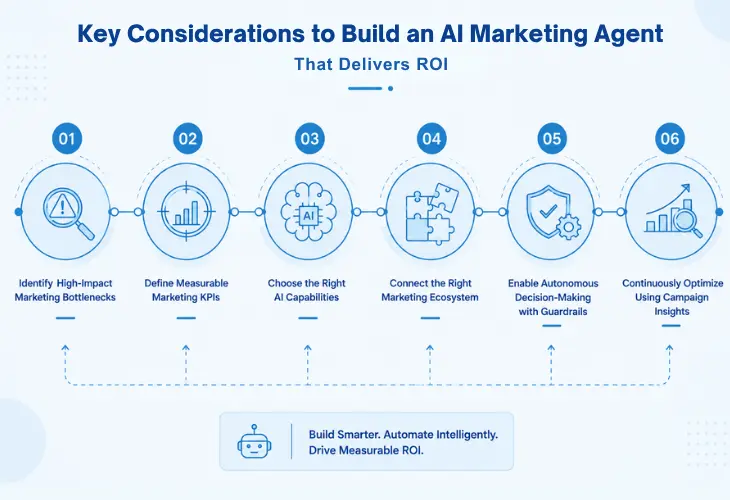
Key Considerations to Build an AI Marketing Agent That Delivers ROI
Building an AI marketing agent is not just about adopting the latest AI technology. It is about solving real marketing problems and delivering measurable outcomes. A successful agent aligns with your business goals, connects to your existing marketing stack and keeps improving based on performance.
Here are the key business decisions that determine its success:
1. Identify High-Impact Marketing Bottlenecks
Start with repetitive, time-consuming or inefficient processes that affect performance. Whether it is lead qualification, campaign optimisation, segmentation or content creation, fixing the right bottleneck ensures your AI agent delivers value quickly.
2. Define Measurable Marketing KPIs
Set the success metrics before development begins. KPIs such as conversion rate, customer acquisition cost (CAC), click-through rate (CTR), lead response time, customer lifetime value (CLV) and return on ad spend (ROAS) help evaluate the agent and guide improvements. Measure them against a holdout group, not just before and after.
3. Choose the Right AI Capabilities
The most advanced AI model is not always the best choice. Select capabilities that match your objectives, such as predictive analytics, content generation, segmentation, recommendation engines or conversational AI. A smaller, cheaper model often handles classification and routing just as well.
4. Connect the Right Marketing Ecosystem
An AI marketing agent performs best with unified customer and campaign data. Connecting it to CRM platforms, marketing automation, analytics, social media and ad networks lets it make informed decisions and deliver consistent experiences.
5. Enable Autonomous Decision-Making with Guardrails
AI should automate marketing decisions within predefined business rules. Approval workflows, spending limits, brand guidelines, compliance policies and human oversight let the agent act independently without risking accuracy, security or brand reputation.
6. Continuously Optimize Using Campaign Insights
An effective AI marketing agent keeps learning after launch. By analysing campaign performance, engagement and market trends, it refines targeting, messaging, budget allocation and strategy to improve ROI over time.
Ultimately, the success of an AI marketing agent depends less on the technology itself and more on the decisions made during development.
Transform Your Marketing with a Custom AI Marketing Agent
Real AI Marketing Agents to Learn From
Studying live products shows what works, and where claims need checking. These are reference points, not endorsements.
| Product | What the agent does | Reported result | How to read it |
|---|---|---|---|
| HubSpot Breeze Customer Agent | Answers customer and pre-sales questions from your knowledge base, hands off to people | Resolves 70 percent of support conversations autonomously, up from 20 percent a year earlier, across 9,000+ customers (Q1 2026) | Vendor-reported average; your rate depends on knowledge base quality |
| Meta Advantage+ campaigns | Automates audience, placement, budget and creative selection for ads | Meta says US advertisers see 22 percent higher ROAS | Haus found 58 percent of brands did better with manual campaigns in 640 incrementality tests |
| Salesforce Agentforce | Agents for campaign creation, segmentation and service inside Salesforce | Salesforce's own survey: only 13 percent of marketing teams use self-directed agents so far | Shows how early the market still is |
| Amazon Rufus | Conversational shopping assistant inside the store | Nearly $12 billion in incremental annualized sales in 2025, by Amazon's attribution | A model for conversational commerce agents |
Three lessons: first, agents with clear knowledge sources (support, FAQs, product data) reach high automation rates fastest. Second, ad-buying agents need independent lift tests because platform-reported ROAS can overstate true gains. Third, a custom agent makes sense when you need to work across several platforms, keep your own data and logic, or serve a niche the big suites ignore.
Key Features of AI Marketing Agents
AI marketing agents combine intelligent decision-making and automation to optimise marketing operations. Key features include:
- Audience Segmentation: Analysing customer data to target specific demographics and behaviours.
- Campaign Automation: Automating repetitive tasks to speed up execution.
- Lead Qualification: Identifying high-quality prospects so sales can focus effort.
- Customer Journey Tracking: Monitoring interactions to improve engagement.
- Predictive Analytics: Forecasting customer behaviour and campaign outcomes.
- Personalized Recommendations: Offering content and products based on preferences.
- Content Generation: Creating marketing materials quickly, with brand checks.
- Email Automation: Personalising and optimising email campaigns.
- Social Media Management: Managing content, scheduling and audience engagement.
- A/B Testing: Testing campaign variations and analysing results.
- CRM Integration: Syncing customer data for personalised experiences.
- Real-Time Decision Making: Adjusting strategy based on live data.
These features help businesses make data-driven decisions, streamline operations and create personalised customer experiences.
Top Use Cases of AI Marketing Agents
AI marketing agents apply across marketing functions, from acquiring new customers to retaining existing ones.
Email Marketing
AI marketing agents create personalised email campaigns, optimise send times and tailor messages based on behaviour to improve open rates and conversions.
Social Media Marketing
They schedule content, monitor engagement, identify trending topics and recommend the best times to post on each platform.
SEO Optimization
AI agents analyse keyword performance, find content opportunities, suggest on-page improvements and track rankings.
Paid Advertising
They optimise targeting, bidding, segmentation and budget allocation to improve return on ad spend across ad platforms.
Customer Retargeting
AI marketing agents identify users who abandoned their purchase journey and deliver personalised ads, emails or offers to bring them back.
Sales Funnel Optimization
By analysing interactions at each stage of the funnel, AI agents find drop-off points and recommend fixes.
Lead Nurturing
AI agents send personalised follow-ups, educational content and engagement campaigns until prospects are ready for sales.
Product Recommendations
Using preferences, browsing history and purchase behaviour, AI marketing agents recommend relevant products that increase cross-selling and upselling.
Customer Support
AI-powered agents answer queries instantly, resolve common issues and assist customers around the clock. For a deeper look at this use case, read about agentic AI for customer service.
As AI technology evolves, the use cases of AI marketing agents keep expanding.
Benefits of AI Marketing Agent Development
AI marketing agent development offers business value beyond workflow automation:
- Increased Conversions: Personalised messages and timely engagement lead to more sales opportunities.
- Better Customer Engagement: Relevant content and recommendations create meaningful interactions.
- Reduced Manual Work: Automation frees marketing teams to focus on strategy and creativity.
- Lower Marketing Costs: Smarter budget allocation reduces customer acquisition costs.
- Higher Campaign Accuracy: Data analysis improves targeting and reduces errors.
- Faster Decision-Making: Real-time processing allows quick responses to market shifts.
- Better Personalization: Tailored experiences match individual preferences.
- Improved Customer Retention: Consistent personalised engagement builds loyalty and lifetime value.
Industries That Can Benefit from AI Marketing Agents
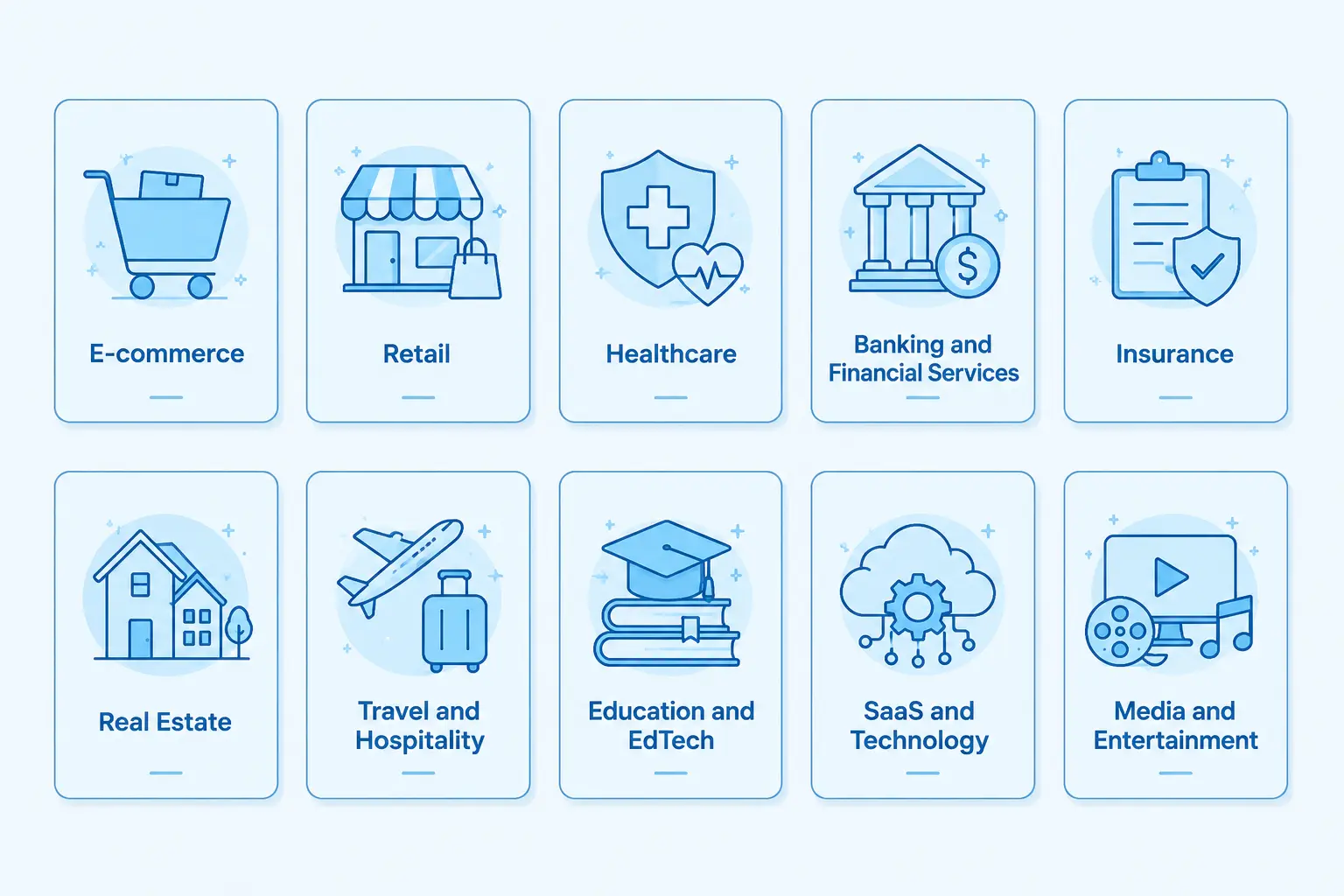
AI marketing agents are changing how businesses attract, engage and retain customers across industries. Whether the goal is personalisation, campaign automation or better marketing ROI, organisations in almost every sector can use them, from e-commerce and real estate to finance, education and healthcare.
Technologies Powering AI Marketing Agent Development
AI marketing agents rely on a combination of AI technologies, data infrastructure and integrations:
- LLMs (Large Language Models): Let agents understand, generate and respond to language naturally.
- NLP (Natural Language Processing): Helps agents interpret queries, analyse sentiment and extract insights from text.
- Machine Learning: Lets agents learn from historical data and improve predictions.
- Predictive Analytics: Forecasts customer behaviour, campaign performance and trends.
- Generative AI: Creates emails, ad copy, blog posts and social captions.
- Vector Databases: Store and retrieve semantic data for contextually relevant responses.
- RAG (Retrieval-Augmented Generation): Retrieves your business knowledge before generating answers, which reduces made-up claims.
- APIs and MCP connectors: Connect agents to third-party platforms for data exchange and actions.
- CRM Integration: Gives agents the customer data needed for personalisation.
- Marketing Automation Tools: Let agents execute, monitor and optimise campaigns across channels.
Compliance Guardrails Every AI Marketing Agent Needs
An autonomous agent can break marketing law at machine speed. Build these checks into the guardrail layer from the start:
| Rule | What it covers | Guardrail to build |
|---|---|---|
| US FTC rule on consumer reviews and testimonials (16 CFR Part 465) | Bans fake reviews, including AI-generated ones, and undisclosed insider reviews | The agent may request reviews but never write or post them |
| US TCPA, as applied by the FCC in February 2024 | AI-generated voices in robocalls count as "artificial", so prior express consent is needed | Block AI voice outreach unless consent is recorded |
| EU AI Act Article 50 | From 2 August 2026, people must be told when they interact with AI, and deepfakes must be labelled | Disclosure text in chat; labels on synthetic images and video |
| GDPR and ePrivacy | Consent for marketing emails and profiling, right to object | Check consent flags before any send; honour opt-outs instantly |
| CAN-SPAM and local spam laws | Sender identity and working unsubscribe links | Templates enforce footer and unsubscribe |
| Advertising standards | No unsubstantiated claims | A claims list the LLM must not exceed, plus human review for new claims |
How Much Does It Cost to Create an AI Marketing Agent?
The cost of developing an AI marketing agent depends on its complexity, AI capabilities, number of channels, integrations, customisation, data infrastructure, security requirements and maintenance. A simple agent for one channel needs far less work than an enterprise system that makes autonomous decisions across many channels.
Here are industry cost ranges with the maths shown, calculated as estimated hours multiplied by offshore rates of $25 to $50 an hour. They are planning figures, not a quote.
| Agent scope | Typical effort | Build cost range |
|---|---|---|
| Single-channel agent (for example, email or lead qualification) with one CRM integration | 300 to 600 hours | $7,500 to $30,000 |
| Multi-channel agent (email, social, ads) with RAG memory, approvals and dashboards | 800 to 1,600 hours | $20,000 to $80,000 |
| Enterprise multi-agent system with custom predictive models, CDP integration and audit logs | 2,000 to 4,000 hours | $50,000 to $200,000 |
Running costs, worked example. Suppose the agent writes 20,000 personalised emails a month and each email uses about 2,000 tokens of input and output. That is 20,000 x 2,000 = 40 million tokens a month. At an assumed blended model price of $5 per million tokens, model usage costs about $200 a month. Add hosting, vector database and monitoring, often a few hundred dollars more, and budget 15 to 20 percent of the build cost each year for maintenance and model updates.
Want to know the exact cost of developing an AI marketing agent for your business?
How to Choose an AI Marketing Agent Builder
Whether you hire an agency or build in-house, score each option on these points:
| Question to ask | A strong answer looks like |
|---|---|
| Have you connected agents to our tools before? | Working integrations with your CRM, email and ad platforms, shown in a demo |
| How do you stop wrong or risky actions? | Spend caps, approval gates, claims checks and action logs designed in, not added later |
| How will we measure lift? | Holdout groups or A/B tests agreed before launch |
| Who owns the data, prompts and code? | You do, with documentation and access to the repository |
| How do you handle security and privacy? | Least-privilege access, prompt-injection testing, PII handling and consent checks |
| What happens after launch? | A support plan with monitoring, retraining and model updates |
Future Trends in AI Marketing Agents
AI marketing agents are evolving from task automation to systems that plan, execute and optimise whole strategies. Key advancements include:
- Autonomous Campaign Management: AI will manage and optimise campaigns end to end, with humans approving goals and budgets.
- Multi-Agent Systems: Specialist agents for content, audience analysis and support will collaborate on shared goals.
- Hyper-Personalization: Agents will tailor offers using real-time customer data.
- Voice Marketing: AI will optimise for voice assistants, within consent rules for AI voices.
- AI-Generated Videos: Agents will create personalised video at scale, labelled as AI-generated where the law requires.
- Agentic Commerce: Customers' own AI assistants will compare and buy products, so brands will market to agents as well as people.
- Predictive Customer Journeys: AI will anticipate customer needs and engage proactively.
Businesses that adopt these innovations early will improve customer experiences and strengthen their competitive edge.
Build Your Custom AI Marketing Agent with Pixel Web Solutions
The future of marketing belongs to businesses that automate intelligently, personalise customer experiences and make data-driven decisions at scale. Through its AI agent development services, Pixel Web Solutions builds custom AI marketing agents tailored to each client's goals and workflows, with the architecture, guardrails and measurement described in this guide. Pixel's broader AI development services cover the data, model and integration work behind them.
Whether you want to automate campaigns, improve engagement or maximise marketing ROI, AI marketing agent development with the right partner turns your marketing operations into an AI-powered growth engine. Talk to the Pixel Web Solutions team to scope your agent.
Frequently Asked Questions
What is an AI marketing agent?
An AI marketing agent is software that uses AI to plan and carry out marketing tasks, such as segmenting audiences, writing and sending campaigns, adjusting ad budgets and reporting results, within rules and budgets that people set.
Can AI marketing agents work alongside my existing marketing team?
Yes. AI marketing agents complement your team by automating repetitive tasks and providing insights. Marketers focus on strategy, creativity and relationships while the AI handles routine operations and asks for approval on important decisions.
Can an AI marketing agent integrate with my existing marketing tools?
Yes. AI marketing agents connect to popular CRM platforms, email software, analytics tools, social media managers and ad networks through APIs or MCP connectors, so data flows and actions happen automatically.
How long does it take to develop an AI marketing agent?
A focused single-channel agent usually takes about 6 to 10 weeks, and a multi-channel agent with integrations and approvals about 3 to 5 months. Enterprise multi-agent systems take longer because of data, security and testing work.
How much does AI marketing agent development cost?
At offshore rates of $25 to $50 an hour, a single-channel agent costs roughly $7,500 to $30,000, a multi-channel agent $20,000 to $80,000 and an enterprise system $50,000 to $200,000. Model usage is a separate monthly cost.
Is AI marketing agent development suitable for small and medium-sized businesses?
Yes. A narrow agent, such as lead qualification or email personalisation, fits SMB budgets and lets smaller teams compete without hiring more staff.
Can AI marketing agents support multiple languages?
Yes. Modern language models understand and generate content in many languages, so agents can run multilingual campaigns. Native speakers should review high-visibility content.
Are AI marketing agents secure enough to handle customer data?
They can be, when built with encryption, role-based access, secure API connections, prompt-injection testing and compliance with privacy laws such as GDPR. Security has to be designed in from the start.
Can AI marketing agents be customized for specific industries?
Yes. AI marketing agents can be tailored to industry workflows, customer journeys and compliance rules in sectors such as healthcare, finance, retail, education and real estate.