









AI in fintech means using machine learning and AI agents to detect fraud, score credit, fight money laundering and serve customers in real time. In 2026 these uses run at scale: HSBC finds two to four times more suspicious activity with 60 percent fewer alerts, Upstart says its model approves 41 percent more borrowers, and Bank of America's Erica has passed 3.2 billion client interactions. The catch is regulation, because credit scoring is high-risk under the EU AI Act from December 2027.
Fintech faces rising transaction volumes, stricter compliance and growing cyber risk. On top of that, customers expect an instant, simple and safe financial experience. Traditional rule-based systems struggle to keep up with these demands, which is why AI in fintech has become core infrastructure rather than an optional innovation.
AI lets fintech businesses handle payments, customers and risk assessment more intelligently and accurately. For founders new to the topic, this guide covers where AI delivers measurable results today, which rules apply in the EU, US, UK and UAE, and how to decide what to build first. Let's start with the foundation.
Key Takeaways
- Adoption is the norm. The Bank of England and FCA found that 75 percent of UK financial firms already use AI, with fraud, AML and cybersecurity among the areas of greatest benefit.
- Four uses deliver most of the value: fraud detection, credit decisioning, anti-money laundering and AI servicing agents.
- Results are real but mostly self-reported. HSBC, Mastercard, Upstart and Bank of America publish strong numbers; plan with them as upper bounds.
- Credit AI carries the heaviest rules. Credit scoring is high-risk under the EU AI Act from 2 December 2027, while AI used only for fraud detection is excluded from that category.
- Start where the data and the maths are clear. The worked example below shows why fraud and AML usually pay back before credit or wealth AI.
Fintech Before AI vs Fintech After AI
Earlier, fintech platforms depended on rule-based systems, manual analysis and static workflows. Risk checks followed a fixed set of conditions, so fraud was often detected only after the money was gone. Customer insights took time to compile and were often incomplete or out of date.
Once AI is part of fintech operations, many core processes change. Instead of reacting after the fact, systems make decisions based on predictions. This shift reflects how AI use cases are transforming other industries by replacing static systems with adaptive intelligence. Risk engines learn from the latest data, fraud patterns are spotted as they emerge, and AI improves the customer experience by learning from customers' habits and behaviour.
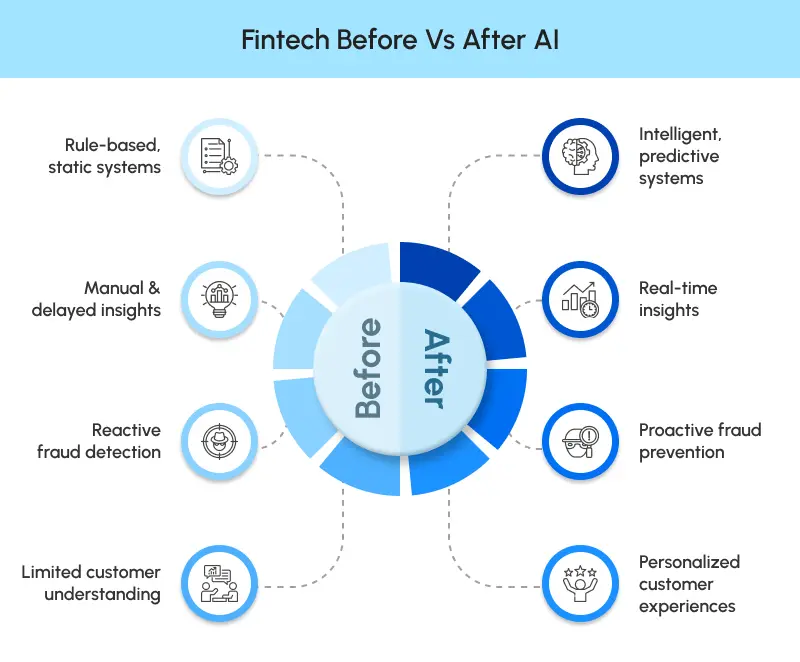
| Area | Fintech before AI | Fintech after AI |
|---|---|---|
| Fraud | Fixed rules, many false alarms, losses spotted late | Real-time risk scores on every transaction |
| Credit | A few bureau variables, slow manual review | Many more data points, instant decisions for most applicants |
| AML | Investigators buried in low-quality alerts | Risk-ranked alerts and case summaries |
| Service | Call centres and email queues | AI assistants available around the clock, with human handoff |
AI in fintech turns an operation-based system into an intelligent one, enabling faster, safer and more convenient financial experiences. Let's look at why adoption is speeding up now.
Why AI Adoption in Fintech Is Accelerating Right Now
Embracing AI is no longer a trend or an experiment for fintech businesses. It has become a necessity as transaction volumes grow and users expect convenience.
- Volume: Fintech firms process huge numbers of transactions, user signals and risk events every day. Rule-based systems cannot analyse this much data quickly, but AI can.
- Security and privacy: Users rank safety first in finance. AI models learn new fraud patterns faster than manually updated rules.
- Instant service: Customers expect immediate credit decisions, personalised financial services and proactive alerts.
- Compliance load: AI can monitor and report continuously, reducing manual errors in AML and transaction monitoring.
The data backs this up. A Bank of England and FCA survey published in November 2024 found that 75 percent of UK financial firms already use AI and another 10 percent plan to within three years. Foundation models already account for 17 percent of use cases, and 55 percent of use cases involve some automated decision-making, although only 2 percent are fully autonomous.
Now it's clear why businesses are adding AI to their financial workflows. Let's see how it is applied.
Key Areas Where AI Is Transforming Fintech Operations
Beyond theory, AI in fintech now has named deployments with published results. Here are the five areas where it matters most.
1. Fraud Detection and Financial Risk Intelligence
AI-driven systems analyse a customer's transaction history in real time to detect fraudulent patterns and anomalies. Machine learning compares each payment with the customer's usual behaviour, the device, the merchant and the wider network, and returns a risk score in milliseconds, with no manual review needed for most transactions.
Real result: Mastercard's Decision Intelligence scores about 143 billion transactions a year. When it added generative AI techniques in 2024, Mastercard said its modelling showed fraud detection rates improve by 20 percent on average and by up to 300 percent in some cases, with scoring completed in under 50 milliseconds. Note that these were Mastercard's projections at launch, not audited bank results.
2. Payments, Lending and Credit Decision Automation
AI automates loan approvals and payment routing by analysing all the relevant information at once. This improves the accuracy of creditworthiness checks and cuts approval times from days to seconds, which helps lenders reach a wider audience.
Real result: Upstart's 2025 Access to Credit Report says its model approved 41 percent more applicants at APRs 33 percent lower than a traditional seven-variable model, and Upstart reports that more than 91 percent of its loans are fully automated. These are Upstart's own comparisons, and credit AI is exactly where regulators look hardest at fairness and explanations.
3. AI Servicing Agents and Personalized Financial Experience
AI lets businesses create a customised financial experience for each customer based on their actions, preferences and risk behaviour. AI assistants answer routine questions, explain spending and send alerts, which reduces the load on support teams.
Real result: Bank of America says Erica has passed 3.2 billion client interactions since 2018, and 20.6 million clients used it nearly 700 million times in 2025 alone. Klarna offers the counterpoint: its AI assistant handled 2.3 million conversations, two-thirds of its chats, in its first month in 2024, but in 2025 the company said quality had suffered and began rehiring human agents for complex cases. The lesson: design a human handoff from day one.
4. Anti-Money Laundering and Compliance Monitoring
Rule-based AML systems produce floods of alerts, and most turn out to be false positives. AI ranks customers and transactions by risk, groups related activity and writes case summaries, so investigators focus on real threats.
Real result: HSBC's AML AI, built with Google Cloud, identifies two to four times more suspicious activity while reducing alert volumes by more than 60 percent, and the bank now detects suspicious accounts within about eight days of the first alert.
5. AI in Crypto, Blockchain and Web3 Fintech
AI can also assess DeFi risk, monitor smart contracts, provide trading intelligence and forecast liquidity. Advanced AI trading bots show how intelligent algorithms can improve trade execution, risk management and market timing, although no bot can guarantee profits. For regulated crypto and payments products, AI also screens wallets and flags risky counterparties. To see how distributed ledgers fit alongside AI, read about blockchain in fintech.
More than improving efficiency, these operational shifts improve business performance and competitiveness.
Business Impact of AI in Fintech Enterprises
AI brings tangible benefits to businesses and delivers measurable outcomes on cost, speed and security.
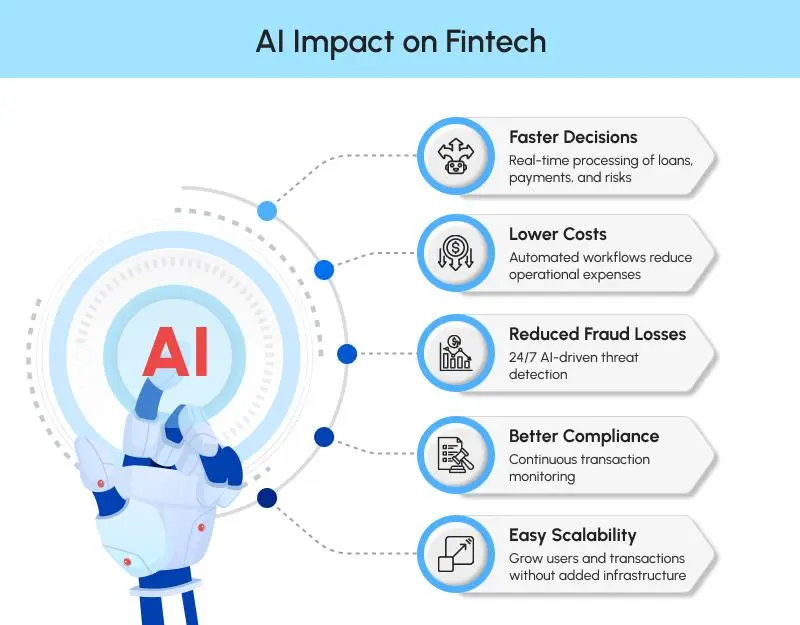
Faster Decision Making
AI processes loans, payments and risk checks simultaneously. It helps financial institutions make decisions in seconds that once took hours or days, as Upstart's automated approvals show.
Lowered Operational Costs
AI handles routine account queries and back-office workflows, so internal costs fall. The automation keeps quality the same or better, provided people review the edge cases.
Reduced Fraud Losses
AI looks for outliers and detects likely fraud before money is lost. It works 24 hours a day, 365 days a year, which closes the gaps that fraudsters target at night and on weekends.
Better Compliance
AI reviews transactions and operations continuously, so issues are detected sooner and documented consistently. HSBC's lower alert volume is a good example of compliance teams getting more done with the same staff.
Scalability
With AI, fintech companies can grow users, transactions and services without adding infrastructure and staff at the same rate. That makes the business more sustainable over time.
AI in Fintech Regulation: A 2026 Checklist by Market
Competitor guides rarely go beyond "stay compliant". Here is what actually applies in October 2026 to the main AI uses in fintech.
| Market | Rule | What it means for fintech AI |
|---|---|---|
| EU | EU AI Act, as amended by the Digital Omnibus (Regulation (EU) 2026/1744) | Credit scoring of individuals and life and health insurance pricing are high-risk from 2 December 2027. AI used purely to detect financial fraud is excluded from that category. Chatbots must tell users they are talking to AI from 2 August 2026 |
| EU | GDPR Article 22 | Customers have the right not to be subject to fully automated decisions with significant effects, such as a loan refusal, without safeguards and human review |
| US | Equal Credit Opportunity Act and Regulation B | Lenders must give specific reasons for adverse credit decisions, even when a complex model made them |
| US | Federal Reserve SR 11-7 model risk guidance | Banks validate, document and monitor models, which supervisors apply to AI models too |
| UK | FCA principles, Consumer Duty and SM&CR | No AI-specific rulebook; firms must show fair outcomes and name a senior manager accountable for AI use |
| UAE | CBUAE guidance note on responsible AI (February 2026) | Licensed firms keep an inventory of AI systems, test for fairness, explain outcomes and keep human oversight. Firms in DIFC or ADGM should also check DFSA or ADGM FSRA expectations |
Practical takeaway: fraud and AML AI carry lighter legal duties than credit AI in most markets, which makes them the lower-risk first projects. If you serve both the EU and the UAE, design one governance process (model inventory, testing log, human override) that satisfies both.
Where to Start: A Worked ROI Example
Competitor articles say AI "reduces costs". The maths below shows when that is true, using clearly labelled assumptions you can replace with your own figures.
Scenario: a card-issuing fintech processes $200 million of payments a year with fraud losses of 0.08 percent, so $160,000 a year.
- If a better model catches 20 percent more fraud (Mastercard's modelled average uplift), losses fall by $160,000 x 20% = $32,000 a year.
- If it also cuts false declines, say 3,000 fewer blocked good transactions at an average of $60, that protects 3,000 x $60 = $180,000 of sales a year, which often matters more than the fraud saving.
- A custom fraud scoring module takes roughly 600 to 1,200 hours, which is $15,000 to $60,000 at offshore rates of $25 to $50 an hour (an industry range, not a quote).
At this volume, payback depends mainly on the false-decline gain, and a licensed vendor tool may beat a custom build. At $2 billion of volume, every figure grows tenfold and a custom model becomes much easier to justify. Rule of thumb: build custom AI where your data gives you an edge; buy or integrate where it does not.
| Fintech AI module | Typical effort | Industry cost range at $25 to $50 per hour |
|---|---|---|
| AI servicing assistant with human handoff | 400 to 800 hours | $10,000 to $40,000 |
| Fraud scoring module | 600 to 1,200 hours | $15,000 to $60,000 |
| AML alert triage and case summaries | 800 to 1,600 hours | $20,000 to $80,000 |
| Credit decisioning with explanations and audit logs | 1,000 to 2,000 hours | $25,000 to $100,000 |
Model usage, cloud hosting and data costs come on top as monthly running costs. For a full product build, see the steps in how to build an AI banking app.
How You Can Approach AI in Fintech the Right Way
In the finance sector, AI can drive risk management, workflow automation and informed decision-making with a fast return on investment. Make sure your AI framework can scale, so you do not need to re-engineer it every year.
Compliance in financial services should never be an afterthought. AI-based systems need transparency and auditability built in, along with the rules on data reporting and anti-money laundering in each market you serve.
A five-step starting plan:
- Pick one use case with clear data and a measurable metric, such as fraud loss rate or alerts per investigator.
- Check the rules in the table above for each market you serve.
- Prepare the data: label past fraud cases, clean customer records and set up consent.
- Pilot with a human in the loop, comparing AI decisions with current outcomes for a few weeks.
- Monitor and retrain: track drift, bias and false positives, and keep an audit log.
For a clear view of the scope and roadmap, engage an AI consultant or AI integration provider. They set up the framework and governance for your AI application, and an experienced development partner reduces implementation risk, controls costs and speeds up your launch.
Why Pixel Web Solutions Is a Trusted Partner for AI-Driven Fintech
Pixel Web Solutions offers comprehensive AI development services, helping fintech, blockchain and crypto businesses with AI consultation, development and integration. With over a decade of industry experience, Pixel focuses on aligning AI capabilities with the real operational needs of the financial industry.
Pixel builds secure, scalable and compliance-ready AI architecture that integrates with existing platforms and blockchain ecosystems. As a fintech app development company operating from Ras Al Khaimah, UAE and Madurai, India, it prioritises clarity, security and execution, so you can adopt AI in fintech with confidence. To scope your project, contact the Pixel Web Solutions team.
Frequently Asked Questions
How is AI used in fintech?
AI in fintech is used for real-time fraud detection, credit scoring and loan automation, anti-money laundering monitoring, AI customer service agents, personalised financial insights, and trading and risk analytics.
Which fintech companies use AI successfully?
HSBC uses AI for anti-money laundering, Mastercard for fraud scoring, Upstart for credit decisions, Bank of America for its Erica assistant and Klarna for customer service, although Klarna has since added human agents back for complex cases.
Is AI in fintech regulated?
Yes. The EU AI Act treats credit scoring as high-risk from 2 December 2027 and requires chatbot transparency from 2 August 2026. GDPR limits fully automated decisions, US lenders must explain adverse credit decisions, and the UAE central bank expects AI inventories, fairness testing and human oversight.
Can AI approve loans automatically?
It can, and some lenders automate most approvals. However, refusals trigger explanation duties in the US and GDPR safeguards in the EU, so most lenders keep human review for declines and edge cases.
What are the risks of AI in fintech?
The main risks are biased credit decisions, unexplainable models, privacy breaches, model drift as fraud patterns change, and poor customer outcomes when AI agents have no human fallback.
How much does it cost to add AI to a fintech app?
A single AI module typically costs $10,000 to $100,000 at offshore rates of $25 to $50 an hour, depending on whether it is a servicing assistant or a full credit decisioning engine. Model usage and hosting are extra monthly costs.