






The best AI business ideas to start in 2026 are AI customer service agents, deepfake and fraud detection, e-commerce personalisation, healthcare support tools, AI tutoring, marketing and content studios, recruitment screening, AI compliance tools, crypto trading tools and personal finance assistants. Each has measurable demand behind it, and most can launch as an MVP for about $7,500 to $60,000 at offshore development rates, with AI usage costs that often run to cents per user per month.
AI technology has changed the digital world, from drafting a perfect email to writing content, setting reminders and answering customers without human intervention. What was once imagination has become reality through AI platforms and software, and AI is now reshaping industries from retail and healthcare to supply chains and cryptocurrency.
The AI space is also crowded, so the winners in 2026 will be startups that pick a real problem, prove demand early and keep their costs under control. This guide lists the top AI business ideas with the demand evidence behind each one, startup cost ranges with the maths shown, and a validation checklist to test an idea before you spend on it. Buckle up to explore the most promising AI business ideas.
Key Takeaways
- Spending is real, not hype. Gartner forecasts worldwide AI spending of $2.7 trillion in 2026, up 49.5 percent, and Stanford's AI Index counts $344.7 billion of private AI investment in 2025.
- Pick ideas with proof of demand. Every idea below comes with a data point, from Adobe's 693 percent jump in AI-referred retail traffic to Deloitte's forecast of $40 billion in US fraud losses enabled by generative AI by 2027.
- MVPs cost less than most people think. A focused AI MVP needs about 300 to 1,500 hours, which is $7,500 to $37,500 at $25 per hour, and model usage can cost under $1 per user per month.
- Regulation is now a design input. Hiring, education and credit tools count as high-risk under the EU AI Act, while health tools may need FDA clearance in the US.
- Validate before you build. Use the 10-point checklist in this guide to test demand, data access, unit economics and regulation first.
Why Pick AI Business Ideas in 2026?
The digital market constantly produces new ideas and new technologies, and AI is the one with the strongest pull right now. The question is whether AI holds up as a business, and the 2026 numbers say yes.
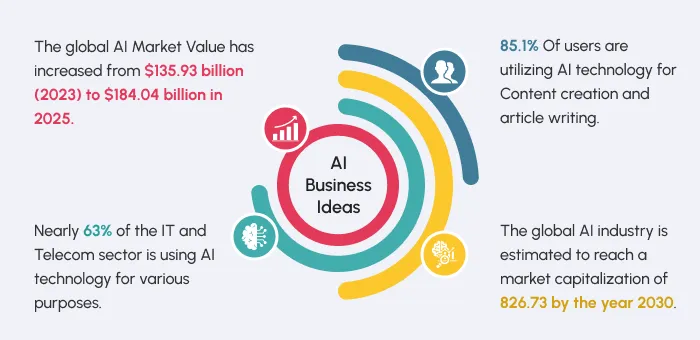
- Spending: Gartner's September 2026 forecast puts worldwide AI spending at $2.7 trillion in 2026, a 49.5 percent increase on 2025.
- Investment: The Stanford AI Index 2026 reports private AI investment of $344.7 billion in 2025, up about 127.5 percent, with the US accounting for $285.9 billion and generative AI capturing nearly half of all private AI funding.
- Adoption: McKinsey's State of AI survey found 88 percent of organisations use AI in at least one business function and 62 percent are at least experimenting with AI agents, yet nearly two-thirds have not started scaling AI across the enterprise.
That last point is the opportunity: most businesses want AI but lack ready-made, reliable tools for their specific workflow. With the right AI business idea, you can:
- Build steady, recurring revenue with a modest initial investment
- Improve efficiency and automation for customers
- Compete with innovative solutions that attract attention from users
- Scale the platform or software as needs change
AI businesses can also launch faster than before, because foundation models are available through APIs. For a broader view of where AI already delivers value, see these top AI use cases.
Top 10 AI Business Ideas to Start in 2026
Each idea below includes what it is, the demand evidence, a typical MVP cost range and why it is worth choosing. Cost ranges are industry estimates for custom builds, calculated as hours multiplied by an hourly rate of $25 to $50.
1. AI Customer Service Agents for Small and Mid-Size Businesses
An AI customer service agent answers customer questions, tracks orders, books appointments and resolves routine requests across chat, email and messaging apps, then hands complex cases to a person.
Demand evidence: Gartner predicts that by 2029 agentic AI will autonomously resolve 80 percent of common customer service issues without human intervention, cutting operational costs by 30 percent. Large companies are already building their own; small and mid-size businesses need affordable, ready-made agents.
Startup cost: about 400 to 800 hours, so $10,000 to $20,000 at $25 per hour or $20,000 to $40,000 at $50 per hour.
Unit economics, worked out: a client with 2,000 conversations a month, each using about 5,000 input tokens and 500 output tokens, uses 10 million input and 1 million output tokens. On Anthropic's published API prices for Claude Sonnet 5.5 ($2 input, $10 output per million tokens), that is $20 + $10 = $30 a month in model costs, against a typical subscription price of a few hundred dollars.
Why Choose This Idea?
- Every business has customer questions, so the market is broad and the value is easy to measure
- Recurring subscriptions with clear, low usage costs
Pixel's AI agent development services cover the agent logic, integrations and guardrails this idea needs.
2. AI Software for Fake Content and Deepfake Detection
As the digital space grows, so do scams, cyber attacks and fake content. AI detection software finds deepfake images and videos, voice clones, misinformation and content spam for banks, newsrooms, social platforms and HR teams.
Demand evidence: Deloitte's Center for Financial Services predicts generative AI could enable US fraud losses of $40 billion by 2027, up from $12.3 billion in 2023, and cites a 2024 case in which an employee in Hong Kong sent $25 million to fraudsters after a deepfake video call.
Startup cost: about 800 to 1,600 hours, so $20,000 to $40,000 at $25 per hour or $40,000 to $80,000 at $50 per hour, plus GPU costs for inference.
Why Choose This Idea?
- Banks, insurers and media firms have urgent, funded demand
- Detection models need constant updates, which supports subscription pricing
3. AI Platforms for E-Commerce and Retail Sites
E-commerce and retail are among the most profitable digital sectors. AI analyses customer behaviour, preferences and purchase history to suggest relevant products, powers visual search by recognising patterns, colours and styles, and helps protect stores from payment fraud.
Demand evidence: Adobe reported that traffic to US retail sites from generative AI tools rose 693.4 percent in the 2025 holiday season compared with the year before, and that these visits converted 31 percent better than other traffic. Shoppers now arrive through AI assistants, so retailers need AI-ready product data and on-site AI shopping help.
Startup cost: about 500 to 1,000 hours, so $12,500 to $25,000 at $25 per hour or $25,000 to $50,000 at $50 per hour.
Why Choose This Idea?
- Raises average order value (AOV) and conversion rates, which are easy for merchants to measure
- Gives merchants data-driven insights for smarter decisions
4. AI Healthcare Tools: Diagnosis Support and Personal Health Plans
AI in healthcare ranges from tools that help clinicians read scans and spot chronic conditions such as diabetes and heart disease, to consumer apps that build personalised diet and fitness plans, track cycles and count steps.
Demand evidence: the US Food and Drug Administration's public list of AI-enabled medical devices runs to well over 1,000 authorised products, most of them in radiology, which shows both demand and a clear regulatory path.
Startup cost: a consumer wellness app needs about 600 to 1,200 hours ($15,000 to $30,000 at $25 per hour). A clinical diagnosis support tool needs 1,200 to 2,500 hours ($30,000 to $62,500 at $25 per hour, or $60,000 to $125,000 at $50 per hour), plus clinical validation and regulatory work.
Why Choose This Idea?
- Large, lasting demand from patients, providers and insurers
- A credible AI health product attracts investors and healthcare partners
Watch out: tools that diagnose or treat count as medical devices in most markets, so wellness apps must avoid medical claims unless they are cleared.
5. Online AI Education and Tutoring Platforms
Unlike traditional education platforms, AI tutoring platforms offer each student a personalised study plan, instant help from AI tutors and practice that adapts to their level.
Demand evidence: a randomised controlled trial in a large Harvard physics course, published in Scientific Reports in 2025, found students learned more in less time with a purpose-built AI tutor, with median learning gains more than double those from an in-class active learning lesson. The gains came from the tutor's teaching design, not from simply plugging in a chatbot.
Startup cost: about 400 to 900 hours, so $10,000 to $22,500 at $25 per hour or $20,000 to $45,000 at $50 per hour.
Unit economics, worked out: a student who runs 60 tutoring sessions a month at 3,000 input and 600 output tokens each uses 180,000 input and 36,000 output tokens. On Claude Haiku 5.5 ($0.10 and $0.50 per million tokens) that costs 0.18 × $0.10 + 0.036 × $0.50 = about $0.04 per student per month; on Claude Sonnet 5.5 it is 0.18 × $2 + 0.036 × $10 = about $0.72. Content and student acquisition, not AI, are the main costs.
Why Choose This Idea?
- Proven learning benefits when the tutor is well designed
- Works for schools, test preparation, languages and corporate training
6. AI Marketing and Content Creation Studio
Marketing drives every business, and AI now handles email campaigns, social media scheduling, customer segmentation, blog drafts, title ideas, SEO briefs and image creation. You can run this as an AI-powered agency, as a software tool, or both.
Demand evidence: McKinsey's State of AI surveys have repeatedly found marketing and sales among the business functions where organisations use generative AI most, and 88 percent of organisations now use AI somewhere in the business. Agencies that combine AI speed with human editing can deliver more work at lower cost.
Startup cost: an agency can start with off-the-shelf tools for a few hundred dollars a month. A custom content tool needs about 300 to 700 hours, so $7,500 to $17,500 at $25 per hour or $15,000 to $35,000 at $50 per hour.
Revenue can come from monthly retainers, premium plans, usage-based pricing or per-project fees.
Why Choose This Idea?
- The fastest idea on this list to launch and test with paying clients
- Low running costs, since text generation on small models costs fractions of a cent per draft
7. AI Recruitment and HR Screening Platforms
AI recruitment platforms reduce the manual workload of HR teams by screening resumes, scheduling interviews and ranking candidates against predefined criteria. The live opportunity in 2026 is screening that is fair, explainable and auditable.
Demand evidence: regulation is turning fairness into a buying requirement. New York City's Local Law 144 requires an independent bias audit within the past year before employers use automated hiring tools, plus notice to candidates. In the EU, AI used in recruitment is high-risk under Annex III of the AI Act, with obligations now applying from 2 December 2027.
Startup cost: about 600 to 1,200 hours, so $15,000 to $30,000 at $25 per hour or $30,000 to $60,000 at $50 per hour, plus the cost of independent bias audits.
Why Choose This Idea?
- Employers pay for time saved and for compliance
- Built-in audit reports become a selling point instead of a cost
Watch out: avoid emotion or body-language analysis in video interviews. The EU AI Act bans emotion recognition in workplaces, and such features add legal risk with little proven benefit.
8. AI Compliance and Governance Tools
Companies adopting AI now need to track their AI systems, test them for bias, document decisions and prove human oversight. Software and services that automate this work are a new and growing category.
Demand evidence: the EU AI Act's transparency duties apply from August 2026 and high-risk duties from December 2027, and the Central Bank of the UAE issued a guidance note on responsible AI in February 2026 that expects an inventory of AI systems, regular fairness testing and human oversight. Every regulated firm that uses AI needs these records.
Startup cost: about 600 to 1,200 hours, so $15,000 to $30,000 at $25 per hour or $30,000 to $60,000 at $50 per hour.
Why Choose This Idea?
- Regulation creates deadlines, and deadlines create budgets
- Strong fit for consultants who already advise on risk or data protection
This guide to building an AI governance framework shows what these tools need to track.
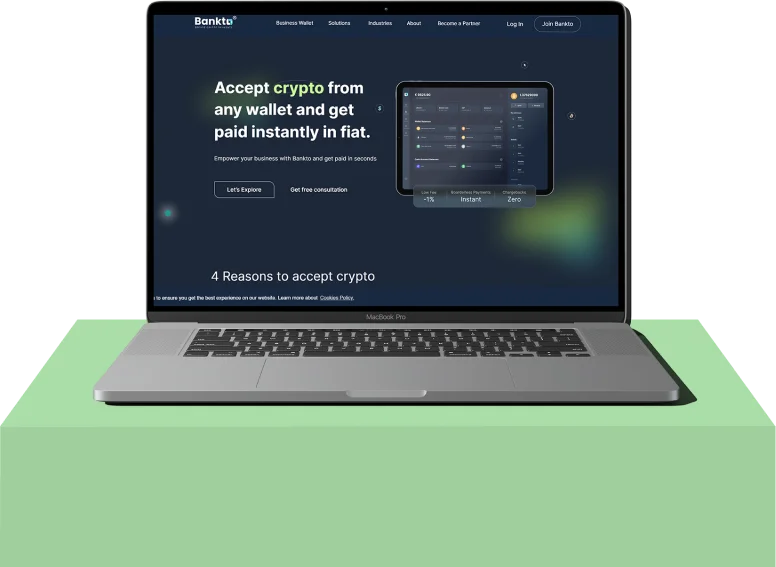
9. AI-Integrated Crypto Exchanges and Trading Tools
Crypto users want user-friendly, reliable platforms, and many startups now start crypto exchange platforms or trading tools that add AI trading bots, chatbots, 24/7 market analysis and risk alerts. AI-powered bots execute trades based on market data, which reduces human error and emotional trading.
Demand evidence: Grand View Research values the automated crypto trading market at $22.2 billion in 2025, growing to $66.6 billion by 2033 at 14.8 percent a year. The regulatory picture is also clearer: the EU's MiCA regulation is fully applicable, and the US GENIUS Act for stablecoins became law in July 2025.
Startup cost: Pixel Web Solutions builds single-strategy trading bots from $6,000, and white-label crypto exchanges from $25,000 to $50,000. AI signal models and multi-user platforms cost more.
Why Choose This Idea?
- Trading fees and subscriptions create revenue from day one
- Cloud-based AI solutions scale as the user base grows
Watch out: regulators warn that no AI can guarantee trading returns, so market your product on speed, discipline and risk control, never on promised profits.
10. AI Personal Finance and Banking Assistants
AI finance assistants categorise spending, predict bills, warn about overdrafts, answer money questions and help users save. They can be sold as consumer apps or as white-label modules for banks, credit unions and fintechs.
Demand evidence: Bank of America's virtual assistant Erica passed 3 billion client interactions and nearly 50 million users by August 2025. Smaller banks want the same capability without building it themselves.
Startup cost: about 800 to 1,500 hours for AI features on top of a banking partner, so $20,000 to $37,500 at $25 per hour or $40,000 to $75,000 at $50 per hour. See the full breakdown in this guide on how to build an AI banking app.
Why Choose This Idea?
- Proven at scale by major banks, with clear demand from smaller ones
- B2B licensing to financial institutions brings larger, longer contracts
More AI Business Ideas Worth Watching
- AI gaming platforms: AI-driven characters, procedural worlds and in-game assistants. Some startups pair them with NFT marketplaces for player-owned items, although demand for play-to-earn models has cooled.
- Personalised AI home management systems: AI that tracks energy use, air quality and temperature and flags unusual activity through smart cameras, usually sold with subscription monitoring.
- AI supply chain apps: demand forecasting from historical sales and real-time inputs, automated restocking and early warnings about supplier disruption.
If you also want to combine AI with Web3, these blockchain business ideas pair well with several ideas above.
AI Business Ideas Compared: Startup Costs at a Glance
| Idea | MVP hours | At $25 per hour | At $50 per hour | Main running cost | Regulatory flag |
|---|---|---|---|---|---|
| AI customer service agents | 400 to 800 | $10,000 to $20,000 | $20,000 to $40,000 | Model usage per conversation | Disclose AI to users (EU AI Act) |
| Deepfake detection | 800 to 1,600 | $20,000 to $40,000 | $40,000 to $80,000 | GPU inference | Low |
| E-commerce personalisation | 500 to 1,000 | $12,500 to $25,000 | $25,000 to $50,000 | Hosting and embeddings | Consumer data privacy |
| Healthcare support tools | 600 to 2,500 | $15,000 to $62,500 | $30,000 to $125,000 | Clinical validation | FDA or local device rules |
| AI tutoring | 400 to 900 | $10,000 to $22,500 | $20,000 to $45,000 | Content and model usage | High-risk in EU for some uses |
| Marketing and content studio | 300 to 700 | $7,500 to $17,500 | $15,000 to $35,000 | Model usage | Label AI content where required |
| Recruitment screening | 600 to 1,200 | $15,000 to $30,000 | $30,000 to $60,000 | Bias audits | High-risk in EU; NYC LL144 |
| AI compliance tools | 600 to 1,200 | $15,000 to $30,000 | $30,000 to $60,000 | Regulatory content updates | Low |
| Crypto trading tools | Varies by product | Trading bot from $6,000 (Pixel price, single strategy) | White-label exchange $25,000 to $50,000 (Pixel price) | Market data and servers | Licensing if you handle client funds |
| Personal finance assistants | 800 to 1,500 | $20,000 to $37,500 | $40,000 to $75,000 | Model usage and monitoring | Financial regulators, GDPR |
These AI business ideas can launch within a startup budget, and each has evidence of real demand. The next step is to prove that demand for your version before you build it.
How to Validate an AI Business Idea: A 10-Point Checklist
Most AI startups fail on demand or economics, not on technology. Work through this checklist before you commit a development budget.
- Name the buyer and the problem. Write one sentence: who pays, for which painful and frequent problem. "Dental clinics that miss calls after hours" beats "businesses that need AI".
- Find proof people already pay. Look for competitors, existing budgets, agencies doing the work by hand or job ads for the task you want to automate.
- Interview 15 to 20 potential customers. Ask about the last time the problem happened and what it cost them, not whether they like your idea.
- Run a manual test. Deliver the service by hand with off-the-shelf AI tools for a few customers before writing code.
- Pre-sell. Aim for paid pilots or deposits, for example 5 to 10 paying customers, before the full build.
- Check your data rights. Confirm you can legally access, store and use the data your model needs.
- Do the unit economics maths. Estimate tokens per user per month, multiply by the model's published price, and compare with your planned price, as in the tutoring example above.
- Map the regulation. Check the EU AI Act's high-risk list (employment, education, credit and more), FDA rules for health, NYC Local Law 144 for hiring and CBUAE guidance for finance in the UAE.
- Set an accuracy bar and a fallback. Decide what error rate customers will accept and how a person takes over when the AI is unsure.
- Test defensibility. Ask what stops a competitor copying you in a month: proprietary data, deep workflow integration or distribution. A thin wrapper around a public model is easy to copy.
If an idea passes most of these tests, you have a business worth building. If you want an outside view first, Pixel's AI consulting services can review the idea, data and costs with you.
How to Create an AI Business Project
Creating an AI startup is not a simple task, but a clear process makes it manageable. Here are the steps to execute an AI business plan.
Steps to Follow
- Find a real-world need or problem that AI can solve, and validate it with the checklist above.
- Understand the relevant AI applications, their common use cases and their impact.
- Choose a business model (subscription, usage-based, licensing or services) that you can launch quickly.
- Develop the AI platform or software with essential features, security mechanisms and the right infrastructure, starting with an MVP.
- Test in several stages, including accuracy and safety testing of the AI itself, then launch to a small group before scaling.
These steps produce reliable AI platforms with the right features. However, you need the right team to execute the plan: AI developers, testers, domain experts and legal advisers.
From Picture to Possibilities: AI Development From Pixel Web Solutions
Pixel Web Solutions offers AI development services tailored to each business's requirements. Its development team integrates AI with existing systems, whether that means AI-driven chatbots and agents, predictive analytics or automated content generation.
Pixel customises AI solutions to specific business needs at a cost that suits a startup's budget, and delivers full AI services and products, from consulting and prototypes to production systems. If you are ready to start your AI business, get a quote from the Pixel Web Solutions team.
Frequently Asked Questions
How do AI platforms make money?
AI platforms earn through subscriptions, usage-based pricing, enterprise licensing, services and, for some consumer products, advertising. The best model depends on the platform type: business tools usually charge monthly subscriptions, while developer tools often charge per use.
Can we integrate AI technology into existing platforms or mobile applications?
Yes. Many businesses add AI and machine learning to existing platforms through APIs, pre-trained models and cloud AI services, without rebuilding the product.
How much does it cost to create an AI-based platform?
Most AI MVPs cost about $7,500 to $60,000 at offshore rates of $25 to $50 per hour, based on 300 to 1,200 hours of work. Regulated products, such as clinical health tools, can cost $60,000 to $125,000 or more. Model usage is a separate monthly cost, often under $1 per user for text-based features.
Which AI business is most profitable?
Business-to-business tools with recurring subscriptions, such as AI customer service agents, compliance tools and vertical software for one industry, tend to be the most profitable because customers pay monthly and usage costs are low. Profit depends on validated demand, not on the idea alone.
What is the cheapest AI business to start?
An AI marketing and content agency is the cheapest to start, because you can begin with off-the-shelf tools for a few hundred dollars a month and add custom software once clients are paying.
Do I need to train my own AI model?
Usually not. Most AI startups use foundation models through APIs and add value with their own data, workflows and integrations. Training custom models makes sense later, when you have unique data and enough volume to justify the cost.
Can I start an AI business without coding skills?
Yes. You can validate an idea with no-code tools and off-the-shelf AI services, then hire a development partner to build a custom product once demand is proven.
The right AI business ideas in 2026 combine real demand, sound unit economics and a clear view of regulation. Pick one, validate it with the checklist, launch a focused MVP and grow from there.
Disclaimer: The cost estimates in this blog are for informational purposes only and are not a quotation. The cost values are approximate industry ranges and may vary with project requirements and the services selected. Except where stated, they are not official Pixel Web Solutions prices for the mentioned service or product. Connect with the Pixel Web Solutions business team for a tailored cost estimate and personalised consultation.